Study reveals that nightjars, a nocturnal visually-oriented bird, depend on moonlight to forage efficiently on insects and maintain their energy balance.
Data collected over more than a decade uncover a suite of adaptations that allow them to survive moonless periods, although only full moons provide enough energy to meet the high costs of reproduction and migration.
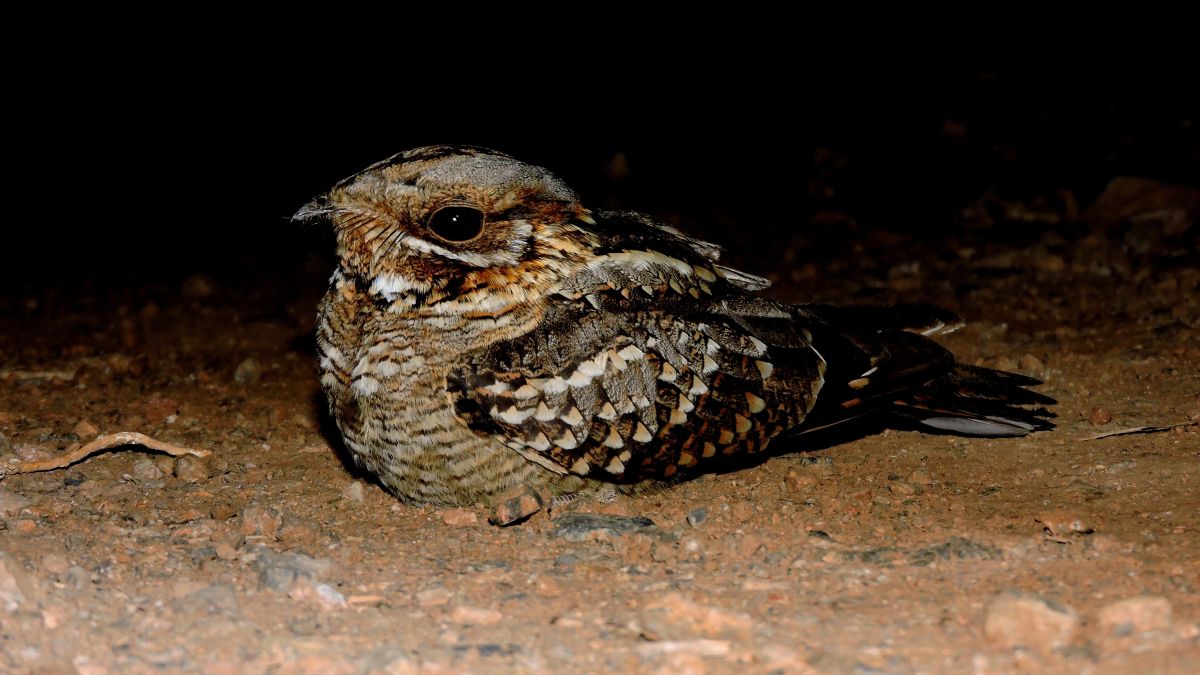
Red-necked nightjar resting at night. Photo: José Manuel Zamora-Marín.
A scientific team led by the Doñana Biological Station (EBD-CSIC) and Lund University has investigated the role of lunar cycles across multiple aspects of nocturnal organisms’ behavior and physiology. The study, published in Science Advances, was conducted in the Doñana National Park (southern Spain) as part of a long-term monitoring program focused on the elusive red-necked nightjar, a nocturnal migratory bird restricted to Mediterranean regions.
The sun rises every day, but the moon not
Nightjars feed on aerial insects at night, but unlike bats, they cannot orient well in complete darkness and require some light to detect their prey. The moon—the main natural source of nocturnal illumination—boosts their visual performance, allowing them to extend hunting activity throughout the night and maxim-ize food intake. But what happens during the darker phases of the lunar cycle?
This was the central question addressed by the study. To answer it, researchers equipped nightjars with miniaturized electronic devices that continuously recorded their behaviour over a full annual cycle. Over more than a decade, they also documented changes in body mass, fat reserves, and stomach fullness—a proxy for food intake—in relation to lunar phases. In the absence of moonlight, nightjars are forced to concentrate their activity around the brief twilight periods of dusk and dawn, the only times when they can detect prey effectively. The study shows that nightjars possess a key adaptation to cope with this time constraint: one of the largest stomachs, relative to body size, among birds, enabling them to gorge on in-sects within minutes after sunset and store them for later digestion.
Fast food, not-so-fast digestion
Thanks to their large stomach, nightjars can ingest enough insects during twilight to partially offset the re-duced feeding time during the new moon phase. However, this adaptation comes at a cost: the stomach is so large that little space remains for the intestine to process the food. The study reveals that digestion in these birds is exceptionally slow, creating a bottleneck that limits how much food they can process over a full night, even under optimal moonlight conditions.
“These animals live on the edge of an energy deficit. For them, the full moon is just a modest bonus in-come that, added to a very tight baseline budget, temporarily eases their precarious energy balance and allows them to cover certain costs—but never in excess,” explains Dr. Carlos Camacho, researcher at the Doñana Biological Station (EBD-CSIC) and first author of the study.
Energy-saving strategies
The suite of adaptations that nightjars use to cope with the recurring energy shortfalls imposed by the lu-nar cycle does not end there. When daily intake is limited, they can further reduce expenditure without drawing too much on reserves. How do they do it? As in any budget: when income drops, spending must decrease. In the absence of moonlight, these birds minimize energy expenditure by remaining largely inac-tive for most of the day and night. Most strikingly, they can also lower their body temperature to further reduce baseline costs. Turning down the “heating” is an effective saving strategy not only in human house-holds, but also in nature, as the study shows.
“Nightjars activate this energy-saving mechanism, known as torpor, on a monthly basis, temporarily lower-ing their body temperature by about 5°C during moonless nights and returning to normal when the full moon restores foraging opportunities,” explains Dr. Gabriel Norevik, co-author of the study and researcher at Lund University in Sweden.
Bound to the rhythm of the moon
Overall, their energy budget fluctuates with the lunar cycle, shifting from deficit to modest surplus once each month. This fluctuating economy, governed by the moon’s monthly rhythm, forces nightjars to syn-chronize their most demanding activities with periods of high lunar illumination.
“Only then can they acquire enough energy to meet the additional costs of reproduction and migration, when they must not only sustain themselves but also invest resources in feeding their offspring or storing fat as fuel for their migratory journeys,” explains Prof. Anders Hedenström, a leading expert in bird migra-tion at Lund University.
This pioneering study highlights the importance of lunar cycles as a key structuring force in nocturnal bio-diversity, providing new insights into the adaptations that allow nocturnal predators to cope with the recur-ring feast–famine cycles imposed by moonlight. However, important questions remain, such as the impact of light pollution on these natural patterns and its potential consequences for the ecology and conserva-tion of nocturnal species in a rapidly changing world.
The study was carried out in collaboration with Pablo de Olavide University and the Observation.org plat-form.
Referencia
Camacho, C., Norevik, G., Sáez-Gómez, P., Hidalgo-Rodríguez, P., Rabadán-González, J., Åkesson, S. & Hedenström, A. Moonlight drives the energy balance and annual cycle of a nocturnal forager. Science Ad-vances, in press. https://doi.org/10.1126/sciadv.aed8204 .