Scientists question the scientific validity of a method that uses caged birds to conduct population surveys
The criticism forms part of a broader debate about the use of scientific arguments to justify previously prohibited practices.
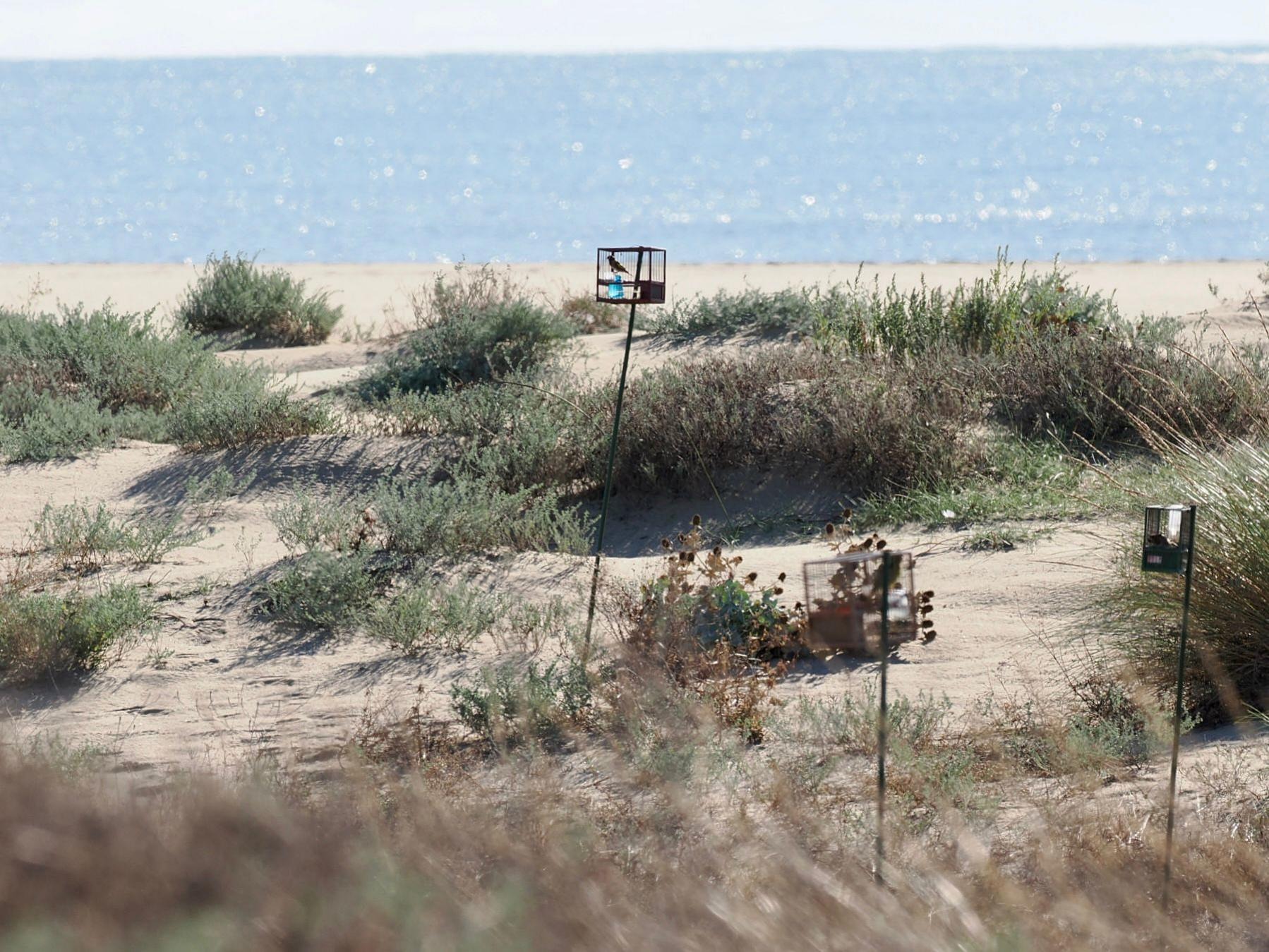
Several caged decoys are placed around the clap-trap to attract finches in the methodology proposed. Credit: Juan José Negro
Researchers from several Spanish universities and research centers, including several from the Doñana Biological Station (EBD-CSIC), have issued a strong critique of a recent study proposing the estimation of bird populations by using live caged birds as decoys.
The criticism, published as a Letter in the journal Ecological Indicators, questions the methodological foundations, statistical validity, and the ethical and legal implications of the procedure, referred to as “attraction points.” According to the signatories, this method should not be adopted as a management or conservation tool.
The study entitled “Attraction points: A new sampling design method to quantify common finches’ population” (Marazuela Pinela et al., 2025) proposes counting birds such as goldfinches, greenfinches, and linnets by using caged individuals to attract wild birds to fixed sampling points. According to the authors of the Letter, this procedure—known as “attraction points”—contains significant methodological shortcomings and does not allow for reliable estimation of true population size.
On the one hand, uncontrolled behavioral biases exist, as not all individuals respond equally to decoys. On the other hand, the method conflates movement with density, reflecting the flow of certain individuals rather than the actual population density within a given area. In addition, the statistical assumptions are questionable, as the analysis relies on distributions that do not adequately fit the nature of ecological data. Finally, the results are considered unreliable because the study does not properly account for how sound propagates across different habitats or how birds actually perceive it.
The Letter also highlights that the proposed method has not been independently validated, nor has it been compared with well-established scientific methodologies such as point counts, transects, or capture–recapture approaches.
Legal context and concerns regarding silvestrismo
The researchers place their criticism within a broader debate about the use of scientific arguments to justify practices that had previously been banned. They recently published another Letter in the journal Science warning of the potential misuse of scientific permits to conceal bird captures in Spain. Following the suspension of hunting permits to comply with European regulations, some regional governments have granted authorizations for captures under purported scientific purposes which, according to the signatories, fail to meet the required legal, scientific, and ethical standards.
The practice of capturing protected wild birds to keep them in captivity —known in Spain as silvestrismo— has been prohibited since 2009 under the EU Birds Directive (2009/147/EC), and is therefore banned under Spanish law. Furthermore, the use of animals for scientific purposes is regulated by Directive 2010/63/EU, which requires prior ethical evaluation and administrative authorization for procedures that may affect animal welfare.
The authors argue that the study in question could contribute to giving a scientific appearance to the reinstatement of this practice.
Established, non-invasive alternatives
Finally, the researchers point out that widely validated and non-invasive methods already exist for monitoring bird populations. In Spain, official long-term programs coordinated by SEO/BirdLife operate within the framework of the Pan-European Common Bird Monitoring Scheme, providing reliable data on population trends through standardized and scientifically robust protocols.
In conclusion, the signatories reiterate that any new methodological proposal intended to influence public policy or environmental management measures must be supported by robust evidence and independent validation.
Reference:
Juan José Negro, Carlos Camacho, José Luis Tella, David Serrano, Miguel Tejedo, Jordi Figuerola, Tomás Redondo, Ismael Galván, Airam Rodríguez, Luis María Carrascal, Luisa Amo, Beatriz Arroyo, François Mougeot, Francisco Valera, Juan Arizaga, Irene Mendoza, José Prenda, Juan Carlos Atienza, Juan Carlos Senar, Víctor Manuel Díaz Núñez de Arenas, Antoni Margalida. Letter to the editor concerning the paper “Attraction points: A new sampling design method to quantify common finches' populations” published by Marazuela Pinela et al. in Ecological Indicators, 171, 113155 (2025). https://doi.org/10.1016/j.ecolind.2026.114719