This is the conclusion of a study co-led by the Doñana Biological Station (EBD-CSIC) after analyzing Google Earth images of more than 1,300 ponds between 2000 and 2022
The study identifies climatic factors and intensive agriculture as the main causes of the degradation of these habitats of great ecological value
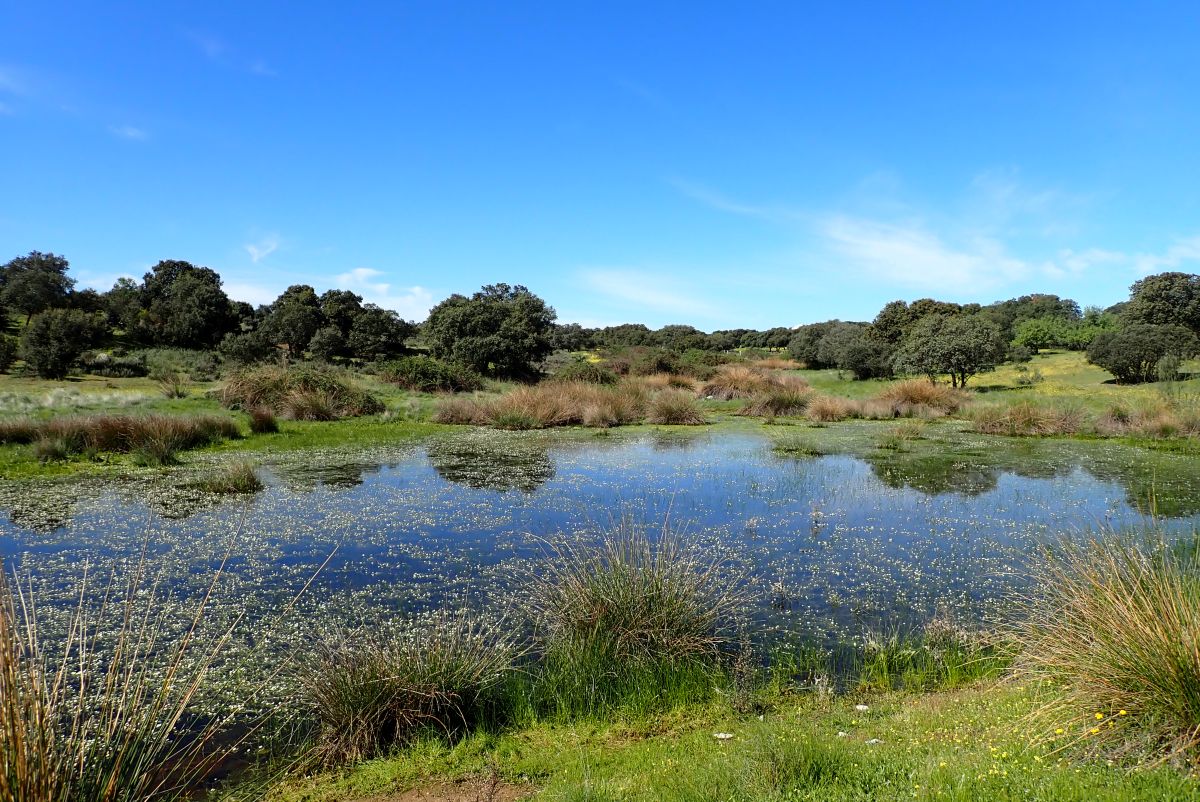
Pond in the dehesa of Chapinería, Madrid. Credit: Christian Arnanz Porras
Researchers from the Doñana Biological Station (EBD-CSIC) and the Autonomous University of Madrid (UAM) have documented the disappearance of 22% of temporary ponds in mainland Spain over the past two decades. The analysis of more than 1,300 ponds using Google Earth Pro imagery points to climatic factors and intensive agriculture as the main drivers behind their pro-gressive disappearance. “The impacts resulting from human activity could be avoided if appro-priate measures are taken,” the researchers highlight.
The study, published in Journal of Environmental Management, is the first large-scale research to quantify the loss and degradation of temporary ponds across mainland Spain. “These ecosys-tems are characterized by irregular cycles of flooding and drying. They are considered priority habitats for conservation by the European Union due to their high biodiversity and extreme vul-nerability to environmental changes,” explains Margarita Florencio, researcher at EBD-CSIC and co-author of the study. “Spain hosts one of the largest representations of this type of habitat in Europe, so we have an important role in its conservation.”
Main causes of their dissappearance
To carry out the study, the team analyzed high spatial resolution Google Earth Pro images from the period between 2000 and 2022, with the collaboration of the Remote Sensing and GIS Laboratory of the Doñana Biological Station (LAST-EBD). The analysis consisted of a visual interpretation protocol applied to images obtained over time from this platform, whose level of precision allows observation of details down to 30 cm. This methodology made it possible to identify the presence of water and physical impacts caused by human activity, with a level of detail difficult to achieve through satellite imagery, due to the small size of many of these ponds.
In total, 1,303 temporary ponds distributed across mainland Spain were analyzed, and it was observed that a high percentage of them—around 22%—had disappeared.
“Most of these impacts are of agricultural origin, such as plowing of edges and basins, channeling, and artificial deepening,” says Christian Arnanz, researcher at UAM and EBD and co-author of the article. “These are compounded by other threats such as colonization of basins by terrestrial vegetation, urbanization, the presence of livestock with evidence of stabling, and vehicle traffic.” In addition, these impacts are often associated with other factors not detectable with the methodology used—such as overexploitation of aquifers and exposure to agrochemicals—suggesting an even greater extent of degradation.
The study also found a reduction in the frequency of flooding in these ponds, especially during the autumn months. This phenomenon is linked both to climatic factors, such as maximum temperatures and accumulated precipitation, and to the main intensive agricultural practices identified, particularly plowing of basins and the presence of channels.
Likewise, the results suggest that the Natura 2000 Network—the largest ecological network of protected areas in the European Union—has limitations in reducing the incidence of these impacts. In contrast, ponds with additional protection, such as inclusion in Natural or National Parks, show a lower prevalence of these impacts.
Restoration, incentives, and citizen participation
The study reveals a concerning reality, but the scientific team remains hopeful. “The impacts we have observed resulting from human activity could be avoided if appropriate measures are taken,” says Arnanz.
The results highlight the need to expand conservation efforts to ponds without formal protection, integrate monitoring techniques for early detection of degradation, and complement the Natura 2000 Network with additional levels of protection. “Another important aspect is the implementation of financial incentives for the agricultural sector, which would help keep ponds unplowed and establish protective buffer zones with natural vegetation of at least 5 meters around the maximum flooding area,” explain the EBD and UAM researchers.
The team also believes that restoration of disappeared ponds should be prioritized, especially in unprotected and severely degraded habitats. According to the researchers, this priority ecological restoration measure should be complemented by restoring the hydrological functioning of altered ponds, such as those with artificial deepening and channeling. To achieve this, they recommend using original sediment from disappeared ponds, where dormant eggs, structures that allow microorganisms to survive without water (cysts), and desiccation-resistant seeds from organisms that originally inhabited these ponds still remain.
Finally, they emphasize the importance of involving society in the conservation of these habitats. Many temporary ponds, especially smaller ones, cannot be easily detected, even through aerial orthophotography or satellite imagery. For this reason, they encourage citizens to use tools such as the PondMapp app, which allows users to locate, record, and share information about small bodies of water. “This citizen collaboration is essential to improve knowledge and protection of these ecosystems,” Arnanz highlights.
A natural heritage of great value
“Temporary ponds are an invaluable natural heritage,” says researcher Margarita Florencio. “They are true oases of life that host unique and singular fauna and flora, much of it threatened. It should be noted that they can survive extreme drought conditions thanks to unique adaptations, such as the formation of resistant structures like eggs, cysts, and seeds; the flight capability of many insects that allows them to move to areas with permanent water; and the adjustment of larval development of some organisms to the duration of flooding.”
In addition to their ecological value, these ponds provide important benefits to society, such as local climate regulation, carbon storage, nutrient control, and biodiversity conservation. They also represent spaces of great landscape and cultural value. “It is important to raise social awareness for the conservation of these unique ecosystems that form part of our natural heritage, so that all generations can enjoy them,” the researcher concludes.
Referencia:
Arnanz, C., & Florencio, M. Temporary ponds in peninsular Spain: insights for the conservation of a threatened habitat under global change. Journal of Environmental Management. DOI: doi.org/10.1016/j.jenvman.2026.129433