Doñana hosts the first forum on regenerative agriculture and livestock farming in El Rocío
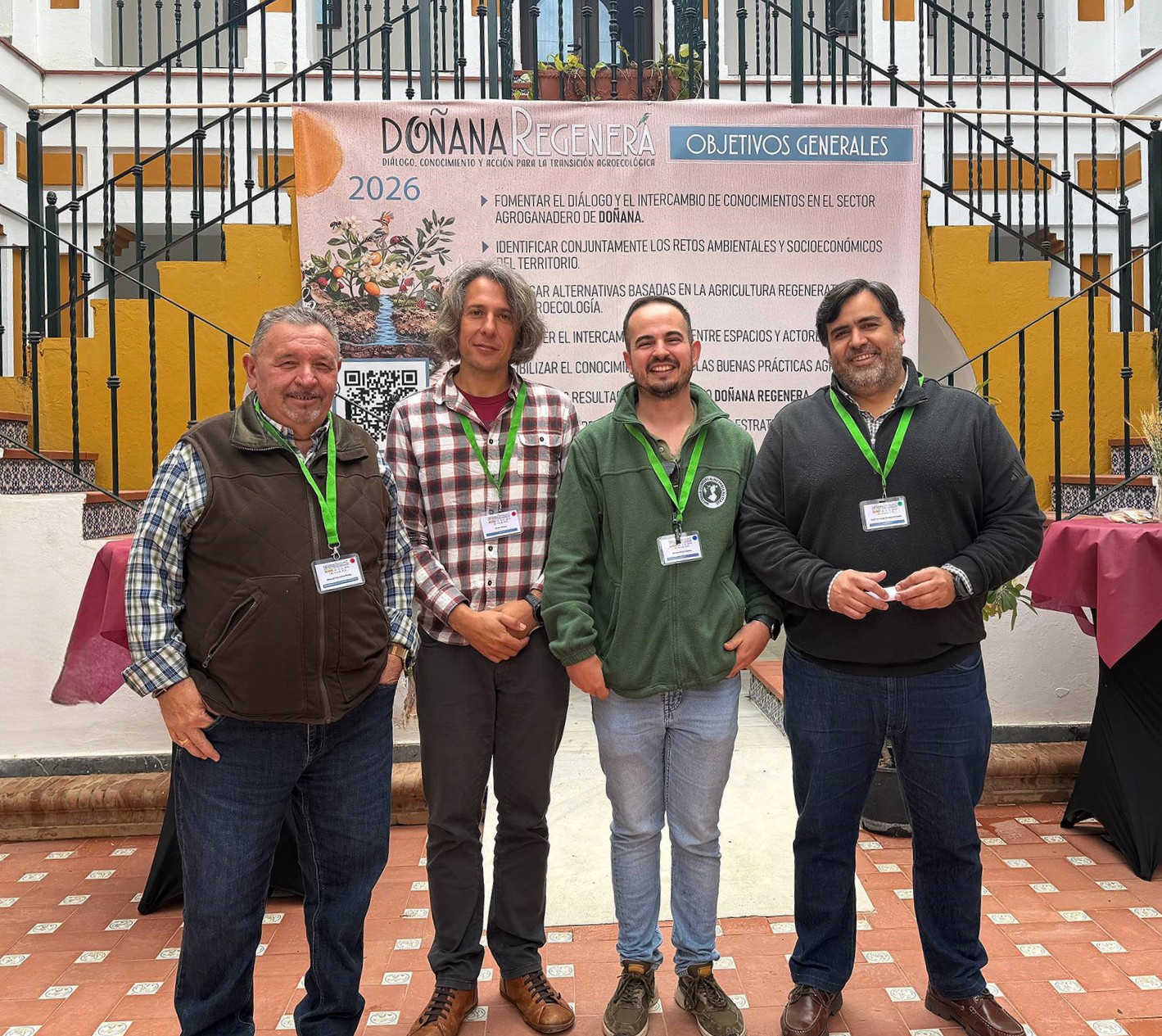
The Puerta de Doñana Farmers’ Association (AAPD) today presented, together with the other partner organizations, the first participatory forum of the project Doñana Regenera. The event marks the starting point for creating, in the Doñana area, “technical and environmental solutions based on science, innovation and ecological restoration that will help better protect a region of such high ecological, socio-economic and human value.”
Project partners include the Doñana Biological Station (EBD-CSIC), the Puerta de Doñana Farmers’ Association (AAPD), ASAJA-Seville and the Sociedad Gaditana de Historia Natural. The initiative is overseen by the Spanish Biodiversity Foundation as part of the Framework for Action for Doñana, funded by the Government of Spain through the Ministry for Ecological Transition and the Demographic Challenge, with the support of the Andalusian regional government and the Provincial Council of Huelva.
The town hall of El Rocío hosted this morning the first joint session of the project, whose motto is “Doñana Regenera: Science-based regenerative agriculture and livestock farming for the sustainability of the Doñana region: mitigating impacts and restoring natural and cultural values.”
This first participatory forum provides a space for dialogue and exchange between scientists and technical experts, representatives of the agricultural and livestock sectors, partner organizations and project members. Its main objective is to present the project’s lines of work and establish a stable framework for cross-sector and interdisciplinary dialogue between the academic, technical and productive spheres in the region.
Through both practical and scientific approaches, the forum aims to “jointly identify the main environmental and socio-economic challenges—both current and future—affecting agricultural systems in the area, and to generate shared visions based on the principles of regenerative agriculture and agroecology,” participants highlighted during the session.
Companies producing berries and citrus fruits in Almonte play a key role in the project. Manuel Delgado, speaking on behalf of the Puerta de Doñana Farmers’ Association, expressed the interest of farmers in the region:
“Doñana Regenera represents a joint commitment between the agricultural sector and the scientific community to move toward production systems capable of effectively addressing today’s environmental challenges. Integrating regenerative practices means not only ensuring the competitiveness of farming, but also protecting Doñana’s ecological richness and the viability of agricultural operations for future generations.”
In the same vein, project coordinator and scientist at the Doñana Biological Station (EBD-CSIC), Óscar Godoy, highlighted the first steps of what he described as an “ambitious” three-year project aimed at achieving “an agriculture that preserves biodiversity and ultimately leads to improved product quality.” To achieve this, the project will promote “greater technological development in crops, which must be combined with the regeneration of ecological processes that foster biodiversity. Doñana is a unique place in Europe—we must take advantage of all the biodiversity it hosts for the benefit of our agricultural and livestock systems.”
Objectives and main lines of action
The forum served to explore and discuss the project’s three main areas of work. The first focuses on transforming agricultural and livestock practices with high environmental costs—especially in key crops such as berries, citrus and olives—by promoting rain-fed systems and supporting the recovery, promotion and commercialization of native livestock breeds.
Secondly, studies will be carried out to increase biodiversity among vertebrate and invertebrate species through active restoration of vegetation and habitats, as well as other advanced technical approaches.
Finally, efforts will focus on integrating, disseminating and transferring the project’s results, assessing their technical, economic and social viability in order to promote practical and replicable knowledge for farmers, associations and public administrations.
The project will also include experimental actions on pilot farms, sector-specific working groups and ongoing knowledge-exchange spaces that will help inform decision-making processes and lay the groundwork for agroecological transition strategies in the Doñana area.
This shared vision highlights the involvement of specialists from different fields, including members of the Gaditana Society of Natural History, who will address “the study and enhancement of biodiversity, both vertebrate and invertebrate, through the application of environmental restoration techniques,” as noted by its president, Álvaro Pérez.
Likewise, José Fernando Robles, project lead at ASAJA-Seville, emphasized that Doñana Regenera represents “an opportunity for farmers and livestock producers in the Doñana area to improve production, reduce costs and increase profitability through a scientific approach that is compatible with the economic viability of farms, while applying practices that care for soil, water, biodiversity and the sustainability of the territory.”
The event was designed from a technical and scientific perspective, avoiding other types of debate and focusing the analysis on the challenges facing the agricultural and livestock sector throughout the entire value chain, with particular attention to its relationship with biodiversity conservation. Contributions gathered during the forum will be incorporated into the development of the project and will help strengthen the environmental, social and economic sustainability and resilience of Doñana’s agri-food system.