A study involving the Doñana Biological Station (EBD) and the Arid Zones Experimental Station (EEZA) has analyzed 62 bird-parasite interactions across 14 European populations at various latitudes, comparing two periods separated by an 11-year interval. These variations are also contingent upon the parasite species; overall, a decline in infection intensity has been observed in recent years.
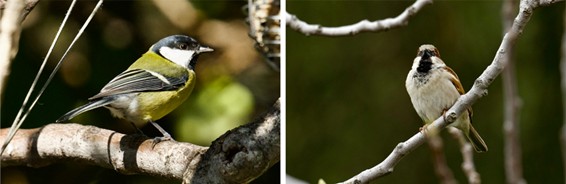
Left to right: great tit (Parus major) and house sparrow (Passer domesticus), two of the nine species studied. / Photo: Santiago Merino
An international study —featuring contributions from the National Museum of Natural Sciences (MNCN-CSIC) and two Andalusian CSIC centers, the Arid Zones Experimental Station (EEZA-CSIC) and the Doñana Biological Station (EBD-CSIC)— demonstrates that the impact of climate change on avian parasitic infections varies significantly by latitude.
To conduct this research, the team studied 14 European populations across a latitudinal range spanning from Southern Europe to Scandinavia. The results, based on a comparative analysis of two periods separated by more than a decade, suggest that global warming is altering bird-parasite interactions, with potential implications for the demography, reproduction, and stability of wild populations.
As essential ecosystem components, parasites regulate host populations as well as the emergence and prevalence of diseases. The changes and ecological mismatches detected in their distribution and intensity may trigger cascading effects on biodiversity. Santiago Merino, a researcher at the MNCN, emphasizes: "Since climate change is altering bird-parasite interactions differently depending on the latitude, we cannot expect uniform responses. This is vital information for designing realistic conservation strategies given the current context of accelerated global warming".
Fewer parasites in the south and complex shifts
For this research, published in the journal PLOS ONE, the team studied nine bird species and 62 host-parasite interactions, including blood parasites, feather ectoparasites, and other parasitic arthropods. The researchers found that, overall, the intensity of parasitic infections has decreased in recent years. This reduction in parasite load was more pronounced at lower latitudes, where temperature increases and droughts have been more severe, whereas changes in parasite intensity were more subtle in Northern Europe.
“Regarding blood parasites, which cause diseases such as avian malaria, their intensity also tended to decrease; however, their prevalence increased, and new parasites emerged that had not been detected during the initial sampling period,” Merino explains. “Our results suggest that the effects of climate change on parasites are neither linear nor uniform across all groups. In the case of these vector-borne blood parasites, factors such as insect availability, humidity, and the birds' immune responses play a critical role,” notes Juan José Soler, a researcher at the Arid Zones Experimental Station.
Changes in avian reproduction and population size
In addition to parasites, the researchers examined demographic and breeding factors, including when the birds lay their eggs and the size of their clutches. “While the trends didn't reach statistical significance, the data suggest that birds are laying eggs earlier, a trend tied to rising temperatures. We also saw a decrease in clutch and brood sizes in many populations. However, these adaptations may not be enough to keep pace with rapid environmental shifts,” notes Alejandro Cantarero of the Complutense University of Madrid.
In addition to the ecological impact, the team notes that certain bird parasites are relatives of pathogens that infect other animals and humans, making this research crucial for global health. Jordi Figuerola, a researcher at the EBD, concludes: "Comparing decades of data across vast geographic scales allows us to see how climate change is reconfiguring biological links. This underlines why long-term monitoring programs are so essential".
This international research was conducted with the participation of the National Museum of Natural Sciences (MNCN), the Doñana Biological Station (EBD), and the Arid Zones Experimental Station (EEZA)—all part of the Spanish National Research Council (CSIC)—alongside the Complutense University of Madrid (UCM), the University of Extremadura, the University of Granada, and several other international organizations.
Reference:
A. Pape Møller, S. Merino, J.J. Soler, F. Adriaensen, A. Cantarero, T. Eeva, J. Figuerola, M. García-del Río, J. Garrido-Bautista, D. Heylen, A. Marzal, E. Matthysen, P. Matyjasiak, A. C. Norte, M. Ruiz. Rodríguez, M. Svobodová, E. Szöllősi, J. Török, F. Valera, J. Veiga y N. Ziane (2026) Temporal changes in intensity of bird parasite infections are dependent on latitude in the Western Palearctic. PlosONE. DOI: https://doi.org/10.1371/journal.pone.0346587