16 April 2026
The reintroduction of 10 tortoises restores ecological processes lost 180 years ago in just 6 months
In two months, the tortoises dispersed more than 11,000 seeds, 89.5% of them from native species, and consumed 54 species of exotic plants
The study shows that each individual plays a different role, with key implications for ecosystem restoration programs
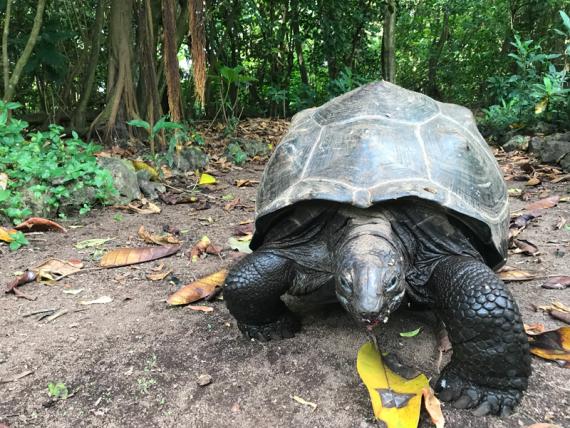
An international study published in Restoration Ecology shows how the reintroduction of just 10 Aldabra giant tortoises (Aldabrachelys gigantea) on Aride Island (Seychelles) has made it possible to restore, in six months, ecological processes that had disappeared more than 180 years ago. The study has key implications for ecosystem restoration programs, as it reveals that individual differences among reintroduced animals—their behavior, diet, and ecological roles—are crucial to the success of these initiatives. In fact, just three of the ten released individuals dispersed more than 80% of native seeds in two months, while others stood out in controlling exotic plants or recycling nutrients.
Giant tortoises became extinct on Aride Island nearly two centuries ago, and with them, important processes that maintained the island’s habitat were lost. Their reintroduction confirms that they act as ecosystem engineers by performing three fundamental ecological functions: controlling the cover of exotic plants; accelerating decomposition and nutrient recycling in soils through the consumption of leaf litter; and dispersing native plant seeds through their droppings after ingesting fruits.
Conducted by researchers from the Doñana Biological Station (EBD), the National Museum of Natural Sciences (MNCN), the Royal Botanical Garden (RJB)—all part of the Spanish National Research Council (CSIC)—and the University of Exeter, the study demonstrates that reintroducing a small number of giant tortoises is a cost-effective restoration strategy capable of reestablishing lost ecological interactions.
The team combined field observations, fecal analysis, and large-scale DNA analyses, which allowed them to accurately identify the species consumed by each individual. “One of the most relevant findings has been discovering that restoration outcomes depend not only on the number of individuals released, but also on their individual behavioral patterns,” says Sergio García-Peña, researcher at MNCN.
The results showed that the 10 reintroduced tortoises dispersed more than 11,000 seeds in two months, of which 89.5% belonged to native species. In addition, they consumed 54 species of introduced plants through herbivory, limiting the growth of exotic flora.
The study revealed striking behavioral variability among individuals. While some tortoises excelled in all three ecological processes simultaneously, others performed poorly across all functions. “The tortoise identified as T08, for example, combined high efficiency in consuming exotic flora with strong dispersal of native seeds and a balanced intake of leaf litter from both native and exotic species. In contrast, T11 showed poor performance in all three processes,” explains Iago Ferreiro Arias from EBD. “This diversity of behavior within the same species is crucial for ecosystem resilience,” he adds.
Implications for conservation
For conservation programs, the research team proposes incorporating the analysis of the effective number of individuals required to sustain ecological processes—a concept that should complement traditional criteria based solely on the genetic viability of populations.
“In small islands like Aride, critical ecological functions may depend heavily on a small number of individuals with different habits. This highlights the need to conserve not only genetic diversity, but also behavioral and functional diversity within reintroduced populations,” explains Iago Ferreiro Arias, researcher at EBD and MNCN.
Pablo Vargas adds: “We are proposing similar fundamental studies on other islands, such as the Galápagos archipelago (Ecuador), where tortoises are not evolutionarily related to those of Seychelles, but their large size also suggests a differentiated role of individuals in these three ecological functions.”
“Besides delivering very positive results, this study shows that the reintroduction of giant tortoises is a more effective and cost-efficient alternative for controlling exotic vegetation than traditional mechanical removal methods,” concludes García-Peña.
Reference:
Ferreiro-Arias, I., García-Peña, S., Kaiser-Bunbury, C., & Vargas, P. (2026). Individual variability shapes interaction rewiring and fosters ecosystem restoration by reintroduced giant tortoises in the Seychelles. Restoration Ecology, e70342. DOI: https://doi.org/10.1111/rec.70342