07 May 2026
Sea lamprey still survives in the Guadalquivir river in southern Spain
Researchers from the Doñana BIological Station (EBD-CSIC) has found a specimen of sea lamprey in the Rivera de Huelva, one of the main Guadalqui-vir’s main tributaries.
The species is critically endangered in Spain and was considered almost extinct in the Andalusian river.
The species is critically endangered in Spain and was considered almost extinct in the Andalusian river.
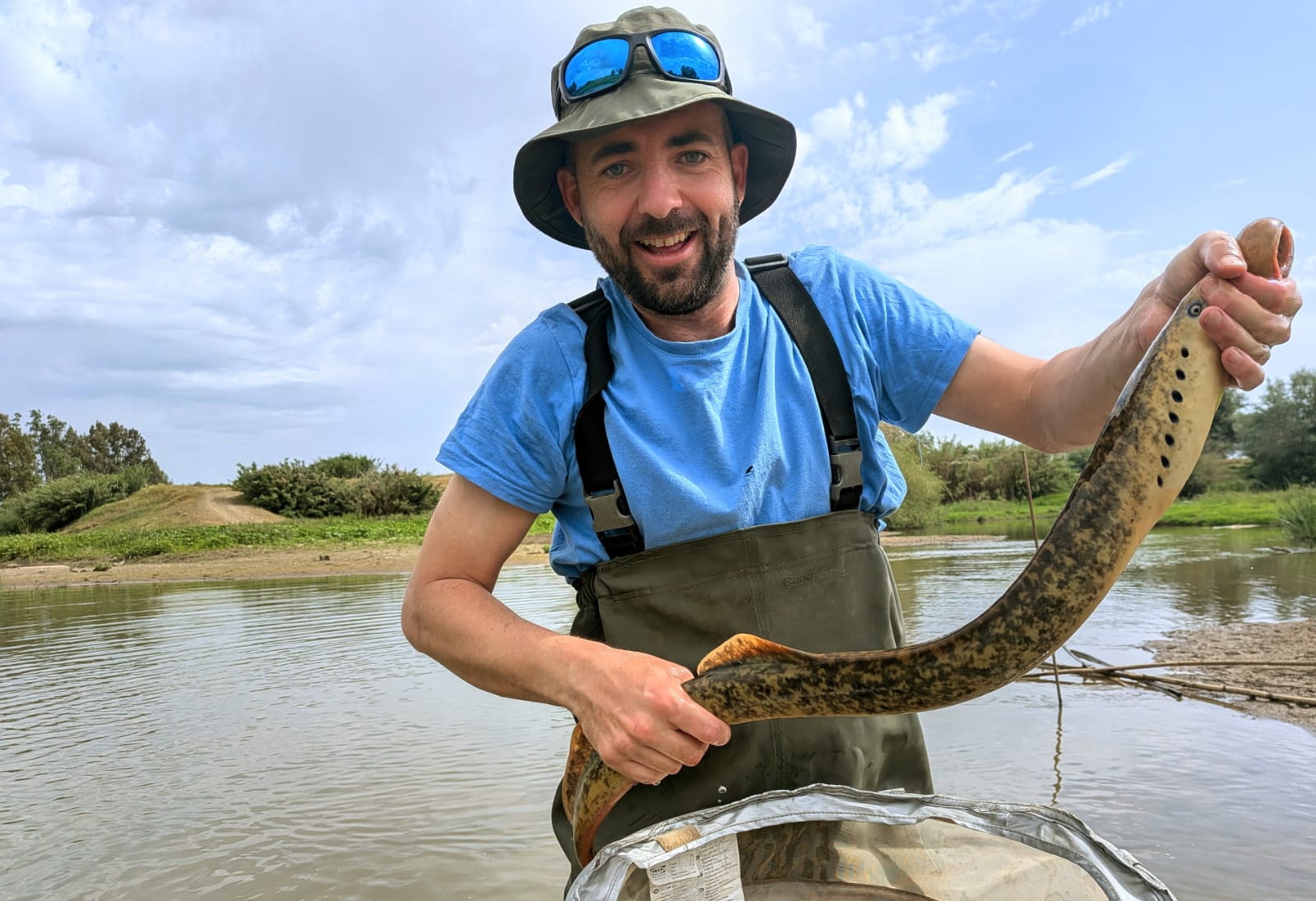
>Researcher Sergio Bedmar with the lamprey captured in the Rivera de Huelva. Credit: Miguel Clavero / EBD-CSIC
The sea lamprey (Petromyzon marinus) is undergoing a steep decline in Spain, where it is classified as Critically Endangered. While northern Spanish populations, mainly in Galicia and Asturias, have fallen dramatically in recent years, the decline began much earlier in rivers along the Mediterranean basin and southern Iberia. In the Guadalquivir River basin, the species has barely been detected during the 21st century and was widely considered almost extinct in Andalusia’s great river. Now, a scientific team from the Doñana Biological Station (EBD-CSIC) has captured an adult lamprey nearly one metre long in the Rivera de Huelva, one of the Lower Guadalquivir’s main tributaries. The finding highlights the importance of the few remaining river stretches that still maintain a connection to the sea and underscores the need to improve our understanding of migratory fish, one of the most threatened groups of animals both in Spain and worldwide.
Migratory fish depend on being able to move between rivers and the sea. Some species, such as the European eel (Anguilla anguilla), reproduce in the ocean and use rivers as nursery habitats. More common, however, are species that hatch in rivers and spend their growth phase at sea. These species, known as anadromous fish, are especially vulnerable to river fragmentation caused by dams, weirs and other barriers, as they often lose access to their spawning grounds. In the Guadalquivir, the Alcalá del Río dam, located just a few kilometres upstream from Seville and operating since 1931, severed the connection between most of the basin and the sea. Anadromous fish suffered the greatest consequences.
“The Atlantic sturgeon (Acipenser sturio) disappeared because of the construction of dams combined with overfishing, and the same happened to the allis shad (Alosa alosa), which used to be fished in Seville” explains Miguel Clavero, researcher at the Doñana Biological Station – CSIC. Until now, the sea lamprey was also believed to have followed the same path towards extinction in the basin.
By the 1970s, the lamprey was already considered rare in the Lower Guadalquivir, with only a few subsequent records, the latest dating from 2014. “However, residents of the nearby town of Guillena told us that when they were young, around 1980, many lampreys were caught in the Rivera de Huelva,” says Sergio Bedmar, researcher at EBD-CSIC. He believes the scarcity of records may partly stem from the lack of a culinary tradition associated with lamprey in southern Spain.
In contrast, the Lower Guadiana still supports a commercial lamprey fishery because of the species’ high value in Portuguese cuisine. As a result, significant efforts have long been invested in the study and monitoring of the species — something that has not happened in the Guadalquivir. These targeted fisheries also generate more frequent and traceable records. “Even so, in the Portuguese Lower Guadiana, fishers complain that it is hardly worth going out to catch them anymore, because the species has become extremely scarce there as well,” Bedmar explains.
A complex life cycle
The sea lamprey follows a fascinating life cycle. Reproductive adults, such as the specimen captured in the Rivera de Huelva, migrate upstream in search of suitable spawning grounds. They build nests in sandy areas, clearing stones away using their suction cup-like mouths. The eggs hatch into larvae that quickly burrow into sandy sediments, where they live by filtering water for food, much like clams. After this filter-feeding stage — which can last more than five years — the larvae undergo metamorphosis. For the first time, they develop functional eyes, a suction mouth lined with horny teeth, and a rasping tongue. This marks their transition into juvenile lampreys, known as macrophthalmia, when they leave the sediment and begin a parasitic phase, feeding on fish to which they attach themselves with their mouths. They then migrate to the sea, where they spend two to three years before ceasing to feed and returning to rivers to reproduce.
Image
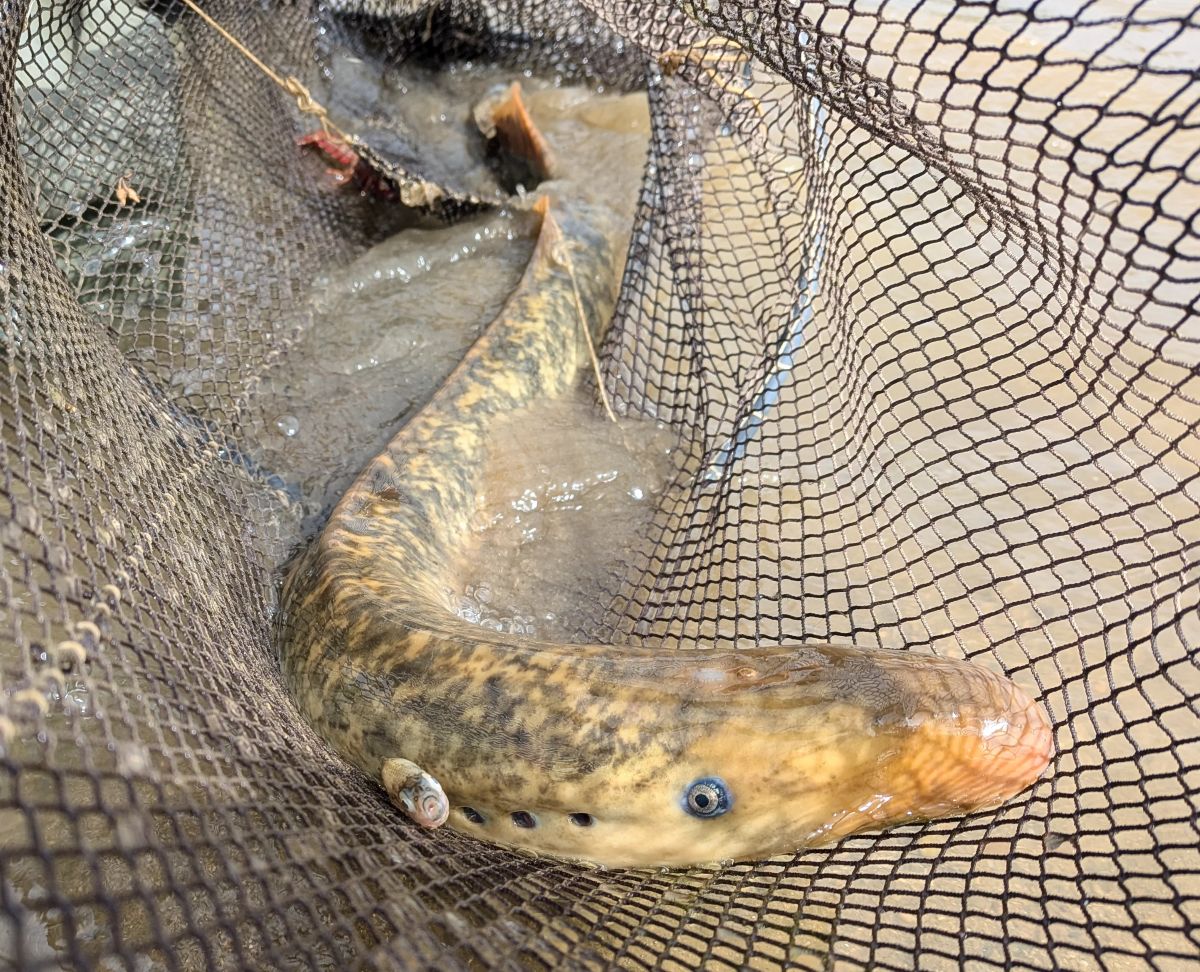
Image of the sea lamprey (Petromyzon marinus) captured by the scientific team from the Doñana Biological Station – CSIC in the Rivera de Huelva. Credit: Miguel Clavero / EBD-CSIC
Lamprey reproduction has never been documented in the Guadalquivir basin, but the stretch where the species has now been detected may provide the right conditions. “This area has extensive sandy beds and a gentle but permanent current, so we believe it could support larvae. In fact, it may historically have been a spawning ground, but it has never been studied,” says Bedmar. “There are very few places left in the entire Guadalquivir basin — if any — that are still so suitable for lamprey reproduction.”
An exceptional and threatened river stretch
The Rivera de Huelva downstream from the Gergal reservoir, which supplies drinking water to the Seville metropolitan area, is exceptional because it is the main river ecosystem in the Guadalquivir basin that still maintains direct contact with the estuary and, through it, with the sea. This stretch is home to eels — many of them very large individuals arriving from the sea — and mullet moving between the sea, estuary and river, alongside typically freshwater species such as barbels, freshwater shrimps and up to three species of freshwater mussels.
“It is probably the most important stretch for the conservation of fish and other aquatic wildlife in the entire Guadalquivir basin,” says Miguel Clavero. Yet river protection schemes, such as protected river reserves, are usually established in mountain areas. “There is a tendency to protect rivers with clean, well-oxygenated waters that are relatively pristine and well preserved. But that does not necessarily mean they are the most important places for biodiversity conservation. Quite often, what is most important is not what is most beautiful,” Clavero notes.
The lower Rivera de Huelva also faces numerous threats, particularly invasive species. The Doñana Biological Station team is currently monitoring two invasive crustaceans there: the red swamp crayfish and the blue crab, which, like eels, reach the area from the sea. In addition, up to eight invasive fish species have been recorded in the stretch, collectively posing risks to the river’s native fauna. “The presence of the wels catfish is especially worrying,” says Bedmar, “because if a well-established population develops, it could prey on the area’s most valuable species, such as the eel — and now we know, the lamprey too.”
The stretch of the Rivera de Huelva still accessible to migratory fish may not be enough to ensure their conservation or recovery. “What we see today is only a tiny remnant of what must once have been the occupation of rivers and streams by migratory fish. We have lost that memory, but these species used to be everywhere, often in huge numbers,” explains Clavero. For the researcher, the discovery of the lamprey is both fascinating and an opportunity to launch new studies on the species’ presence in the Guadalquivir basin. “We are not used to good news when working with river and wetland fish, so we have to celebrate the fact that the species still survives in the Guadalquivir. But the truly good news would be to start restoring at least part of the enormous amount of habitat we have taken away from migratory fish through barriers.”
The researchers argue that removing the barriers created by the Alcalá del Río and Cantillana dams would be essential for the Guadalquivir basin. “These are old, relatively small structures with very limited hydroelectric output, but their impact is enormous. If they were removed, the stretch we study in the Rivera de Huelva would no longer be such an isolated exception, and we would give several fish species on the brink of disappearance a real chance to recover,” Clavero concludes.