A year marked by above-average rainfall give Doñana a breather, but long-term structural challenges persist
However, the data also reflect the persistence of structural problems such as the low number of flooded ponds, the decline of native species, and the impact of invasive species.
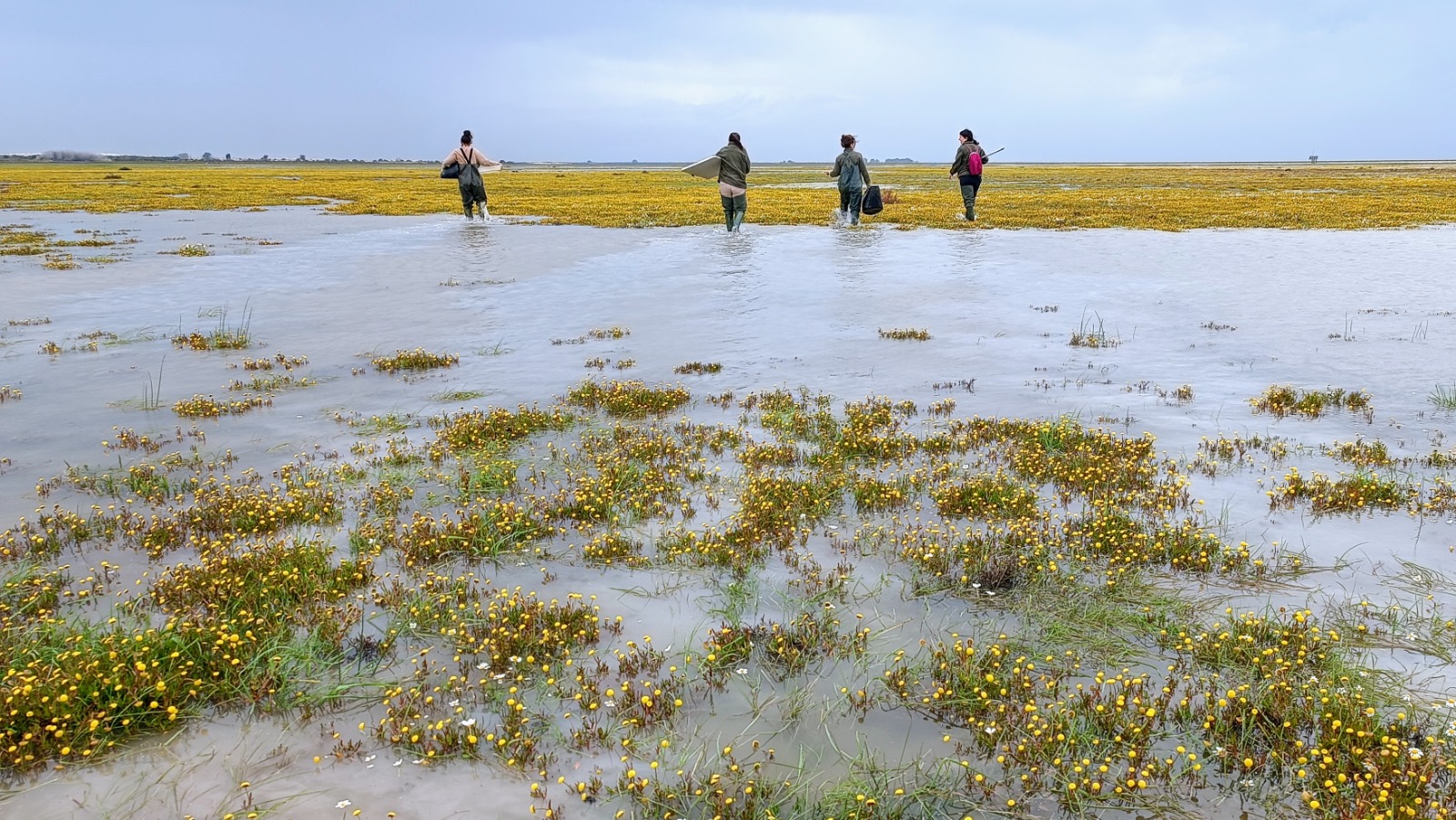
Technical staff from the Doñana ICTS carrying out sampling in the marshland. / J. Manuel Vidal Cordero (EBD-CSIC)
The Singular Scientific and Technical Infrastructure – Doñana Biological Reserve (ICTS-Doñana), part of the Doñana Biological Station of the Spanish National Research Council (CSIC), presented today the report “State of Biodiversity in Doñana 2025”, which includes the results of the environmental monitoring program conducted in the Doñana Natural Area. The data confirm that Doñana continues to have enormous ecological value, but they also reflect a complex situation that combines encouraging signs with worrying symptoms.
“The data show that there are reasons for hope, but continued work on recovery is essential,” said Eloy Revilla, director of the Doñana Biological Station (CSIC), during the presentation. “This year’s rainfall points to a positive evolution for Doñana, although very important problems persist that require constant long-term efforts and cannot be solved with just one good year of rain—or even two”
Above-average rainfall and a revitalized marshland
For more than a decade, Doñana has experienced below-average rainfall, with particularly severe droughts in 2022 and 2023. The 2024–2025 hydrological cycle recorded total rainfall of 675 mm, higher than the historical average of 530 mm. However, beyond the total amount of rainfall, its distribution throughout the year was key.
Rainfall was intensely concentrated over short periods, especially in March, when 287.2 mm were recorded, accounting for 42.6% of the annual total. These rains caused strong surges in the streams that feed the marshland, leading to exceptional flooding. In March 2025, the marshland reached nearly 100% flooding, something that had not occurred since 2010. It remained flooded for 157 days, almost double the historical average of 79 days, placing this cycle among the longest since 1984. The phenocams and flux towers installed within the Doñana Biological Reserve, which analyze vegetation and its environment on a daily basis, also show a marshland with greater plant vigor than the previous year and more than double the productivity.
Ongoing concern over the state of the ponds
However, this exceptional situation was not replicated in the pond system, which is much more dependent on the state of the aquifer than on surface water. Only 53% of the ponds became flooded, reflecting the lack of recovery of the aquifer.
The peridunal ponds—the largest in Doñana (Santa Olalla, Sopetón, and Dulce)—did retain water for much of the hydrological cycle. In particular, Santa Olalla broke with the dynamics of previous years and remained flooded throughout the entire cycle.
In contrast, many temporary ponds that have not experienced recurrent flooding in recent years have shown progressive colonization by terrestrial vegetation, replacing former wet grasslands and hindering future recovery. This colonization responds to a longer-term process and is clearly related to the impact of groundwater extraction.
Waterbirds: low abundance but improved breeding
En cuanto a las aves, la ICTS-Doñana mantiene censos aéreos y terrestres periódicos de aves Regarding birds, ICTS-Doñana maintains periodic aerial and ground censuses of waterbirds. The aerial censuses, initiated in the 1970s, constitute the first standardized monitoring program and have been conducted monthly ever since. The aerial census reflects a modest wintering season, as rainfall occurred mainly from late January onward and especially during spring. In January, 178,907 wintering birds were counted—below the historical average for this month, which stands at around 280,000 individuals, and far from the peaks recorded in the late 1980s and early 1990s, when more than 600,000 birds were observed.
Overall, in 2025 most species show increases in abundance compared to 2024. However, when examining the time series of the last 20 years, a pronounced, sustained decline becomes evident, consistent across both aerial and ground census data. In particular, herbivores, small waders, piscivorous birds, and dabbling ducks are the most affected groups, with especially severe declines ranging from 69% to 80%.
The situation of the greylag goose is particularly striking. This species, deeply embedded in the collective imagination of Doñana, has reached historical lows in wintering numbers, with only 3,500 individuals recorded—figures that raise alarms about its future in Doñana’s winter ecosystem.
With most rainfall occurring in March, the hydrological improvement did not translate into a better wintering season, but it did have a positive effect on breeding. In 2025, the number of breeding pairs increased in 85% of species compared to 2024. Nevertheless, an analysis of the last 20 years remains concerning: nearly three-quarters of species show a decline in the number of breeding pairs, associated with Doñana’s hydrological degradation. In the medium term, declines affect slightly more than half of the species.
Meanwhile, the post-breeding migration bird ringing campaign for passerines, conducted uninterrupted since 1994, shows a relatively stable picture. In 2025, nearly 1,700 birds belonging to 52 species were ringed—figures very similar to the program’s historical average. Presaharan migrants show stability or even slight increases, while trans-Saharan migrants display a moderate decline. These differences may be related to several factors, such as earlier migration timing, shorter stays in the Doñana area, or changes in European stopover and wintering areas.
Amphibians and aquatic insects, the biggest beneficiaries
The rains of the past year have had positive effects on some groups. Aquatic beetles, for example, reached some of the highest abundance levels of the past decade in certain areas, likely thanks to the greater availability of aquatic habitats. Lagoons with longer flooding duration hosted the most diverse communities, highlighting the importance of water and microhabitat availability for maintaining insect biodiversity.
Amphibians were also among the main beneficiaries of the rains, with improved breeding conditions. Notably, the common frog and the spadefoot toad were the most frequently detected species in surveys. The Iberian ribbed newt, for example, has once again been observed in more localities after recent years of drought.
Reptiles such as lizards and geckos maintain high diversity, and areas affected by the 2017 wildfire show notable recovery. The detection of species of conservation interest such as Carbonell’s lizard—an Iberian endemic classified as “vulnerable”—reinforces Doñana’s value for the conservation of threatened species.
Pressure from invasive species
In degraded habitats or those with unstable hydrological regimes, opportunistic and invasive species continue to dominate and remain one of the major challenges for Doñana’s biodiversity. The red swamp crayfish maintains a very high presence in the Doñana Natural Area. The blue crab continues to expand in tidal channels and has reappeared in greater numbers in Veta Lengua than in 2024. For the first time, detailed data have been included on the snail Physella acuta, detected at most sampling points and with high numbers of individuals in some ponds.
Regarding invasive flora, Oxalis pes-caprae, commonly known as Bermuda buttercup, continues to increase its colonization capacity. This species not only occupies increasingly larger areas but also establishes denser populations. In 2025, monitoring of the Argentine ant—also an invasive species—reveals that it remains present in the Doñana Biological Reserve, although without further signs of expansion. This monitoring has been expanded to include the entire community of arboreal ants inhabiting cork oaks, revealing a highly diverse community with more than 20 species typical of Mediterranean ecosystems.
Some native species in critical condition
In many other groups of native species, trends remain worrying. In aquatic environments, the situation of native fish is critical: only three species were recorded in the marshland and one in lagoons, with minimal abundances in spring 2025. In contrast, exotic fish dominate, with species such as mosquitofish—the most widespread—or catfish, which is increasing again.
The situation is also critical for native terrestrial and aquatic turtle species. The spur-thighed tortoise reached one of the lowest abundance values of the entire historical series in 2025. Meanwhile, the Mediterranean pond turtle and the European pond turtle—both listed in the Spanish Catalogue of Threatened Species—recorded population minima. These data highlight the vulnerability of these species to recurrent droughts.
Butterflies recorded one of the lowest abundance levels of the historical series in 2025, possibly affected by torrential rainfall events. Nevertheless, species not observed for years were detected in 2025, such as Cyaniris semiargus, last recorded five years ago, and Laeosopis roboris, whose previous record dated back twelve years.
Regarding mammals, rabbits and hares continue to maintain very low populations, affecting emblematic species that depend on them as prey. Even so, rabbits showed slightly better values than the previous year during the spring period. Wild boar numbers were also slightly higher, although in line with recent years. As for micromammals—rodents and other small mammals—very low numbers were recorded across all species.
Local improvements and long-term negative trends
In conclusion, the data collected over the past year highlight the exceptional value of Doñana for biodiversity conservation. Progress was recorded in 2025, such as the exceptional flooding of the marshland and improved data for some species. Despite this, Doñana continues to face major structural challenges. Limited lagoon flooding, the decline of some native species, and the spread of invasive species, among others, underscore the ecosystem’s fragility. While recent data are encouraging, ensuring Doñana’s ecological value will require sustained actions over time that address these challenges in an integrated manner.
ICTS-Doñana, an infrastructure dependent on the EBD-CSIC, is the largest field laboratory in Europe. It supports research in Doñana and generates key information for the effective management and conservation of the protected area. The environmental monitoring program carried out by ICTS-Doñana is part of the monitoring, evaluation, and scientific knowledge enhancement measures of the Doñana Action Framework, coordinated by the Commissioner for the Water Cycle and Ecosystem Restoration of the Ministry for the Ecological Transition and the Demographic Challenge (MITECO).
The Government of Spain, through MITECO, has designed two Action Frameworks for Doñana that combine environmental restoration and social awareness, seeking to safeguard the ecological values of the area and contribute to economic development that is sustainable and integrated with local needs. A total of thirteen ministries are involved in their implementation.