The genome structure of a starfish could explain how it adapts to highly diverse marine environments
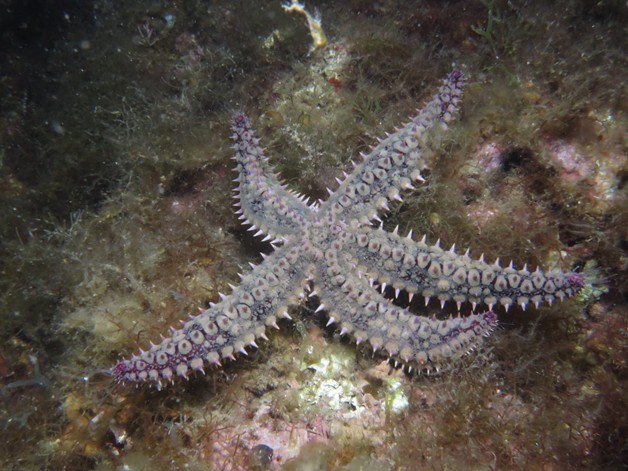
La estrella de mar espinosa (Marthasterias glacialis) habita entornos rocosos desde el Atlántico nororiental hasta los archipiélagos de la Macaronesia y en todo el Mar Mediterráneo. Crédito: Xavier Salvador
At first glance, populations of the spiny starfish inhabiting the Mediterranean and those living in the cold waters of the British Isles appear to belong to the same species without major differences. However, their genome tells a different story. A scientific team led by the Doñana Biological Station and the University of Barcelona has discovered that this species features an unusually high number of chromosomal inversions—large fragments of chromosomes that appear "upside down" in some individuals. These inversions affect 18.6% of its genome and appear to be associated with different environmental conditions.
“The most interesting aspect is that the variants of these inversions are not distributed randomly among the studied populations, but instead appear associated with different geographical regions,” explains Carlos Leiva, a researcher at the Doñana Biological Station. “Many of them are more common in warm, saline regions like the Mediterranean, while others appear associated with colder areas, such as the British Isles.”
Within these inverted regions, genes related to thermal stress response, osmoregulation, immune response, and environmental perception have been found—a phenomenon that will need to be validated through experimental studies. Nevertheless, these results suggest that, beyond point mutations, the structural organization of the genome can be especially important for understanding how a species adapts to different environments, even when its populations are highly interconnected, as is the case with the spiny starfish.
A mechanism to preserve local adaptations
The finding is particularly striking due to a phenomenon common in marine organisms: the long-distance mobility of their larvae. Although adult starfish have limited mobility, their larvae can travel hundreds of kilometers driven by ocean currents, continuously mixing populations. In theory, this connectivity should make it difficult for major adaptive differences to emerge between regions. However, the study demonstrates that certain genomic regions escape this mixing.
The study reveals that specific regions of the genome recombine—or "mix"—much less than the rest, allowing them to remain distinct between populations. “These regions act as blocks that are inherited together, thereby preserving beneficial combinations of genes for living in specific environmental conditions, such as differences in temperature or salinity,” explains Marta Martín Huete, PhD researcher at the University of Barcelona.
Nearly 300 specimens studied across the Atlantic and the Mediterranean
To determine whether there were hidden differences in the species' genome, the scientific team analyzed samples from nearly 300 specimens of Marthasterias glacialis from 19 locations across the northeastern Atlantic and the western Mediterranean, including the British Isles, the Azores, the European Atlantic coast, and the Mediterranean.
The team analyzed thousands of markers distributed throughout the entire genome and compared them with a reference genome for the species. This approach allowed them to identify regions compatible with chromosomal inversions and to study how they were distributed among the different populations. Additionally, the genetic data were combined with environmental information on temperature and salinity, making it possible to explore whether chromosomal inversions could be linked to local adaptations.
Implications for marine biodiversity conservation
The work also reveals that a widely distributed species with connected and seemingly homogeneous populations can harbor significant adaptive diversity within its genome. This suggests that different populations of the same species could respond differently to phenomena such as ocean warming or changes in salinity.
Furthermore, the results offer a new perspective on the mechanisms driving the evolution of marine biodiversity. The study highlights that changes in genome structure can be just as important as point mutations in DNA in fostering species adaptation.
“These results open the door to new studies to verify whether these chromosomal inversions actually translate into biological differences between individuals, such as greater heat tolerance, resistance to salinity changes, or variations in growth or reproduction,” explains Carlos Leiva.
What began as a study on a starfish has revealed a new way of understanding how marine organisms evolve. If future research confirms that these chromosomal inversions determine the ability to adapt to heat or salinity, Marthasterias glacialis could become a model for studying how many marine species might respond in the future to an ocean shaped by climate change.
Researchers from the Doñana Biological Station (EBD-CSIC), the University of Barcelona (UB), the Biodiversity Research Institute (IRBio-UB), as well as the University of Guam, the Botanical Institute of Barcelona (IBB-CSIC) and the University of Rennes participated in the study.
Scientific reference:
Martín-Huete M., García-Berro A., Mérot C., Pérez-Portela R., Leiva C. (Accepted) Hidden genomic structure and widespread structural polymorphism across environmental gradients in the spiny sea star Marthasterias glacialis. Proceedings of the Royal Society B: Biological Sciences. DOI: https://www.doi.org/10.1098/rspb.2026.0791