Bears adapt their diet to global climate changes, according to a new study
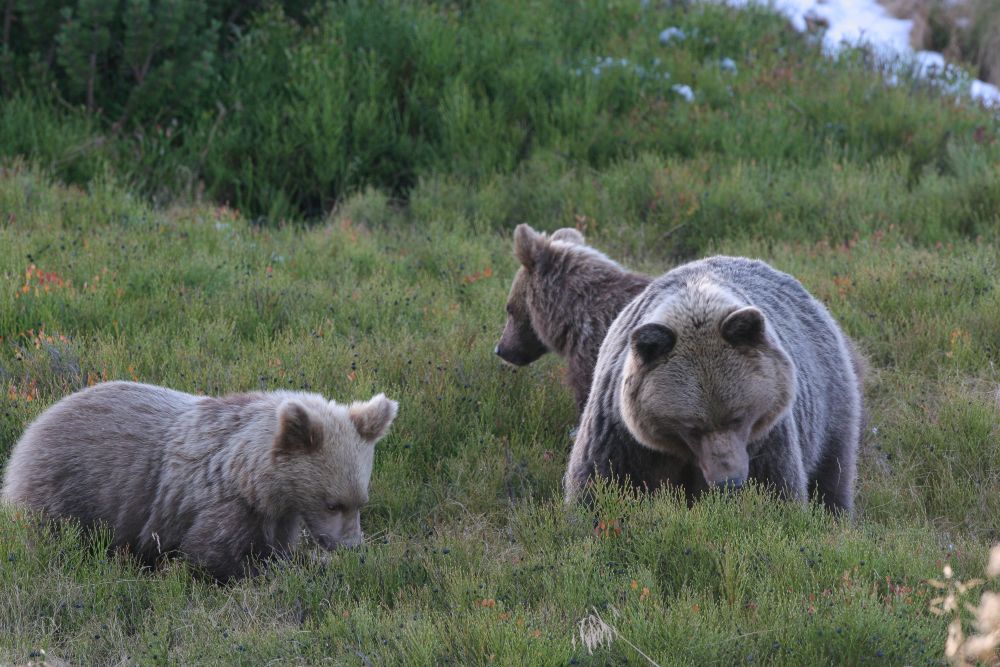
Bear family (femable with cubs) eating bilberries in the Tatra National Park. Photo by Adam Wajrak
Bears are true omnivores, and their dietary flexibility has allowed them to thrive in a wide range of habitats. Now, an international study led by the Senckenberg Biodiversity and Climate Research Center (SBik-F) in Frankfurt, the Polish Academy of Sciences, and the Doñana Biological Station – CSIC reveals that most bears can adjust their diets according to climate and food availability, thereby modifying their ecological roles. Published in Nature Communications, the study suggests that changes in the roles of large omnivores could strengthen ecosystem resilience in the face of global environmental changes.
Bears, the Large Omnivores
Bears can have highly diverse diets, including berries, roots, nuts, grasses, as well as insects, fish, and mammals. Diet composition varies by species and season. For example, brown bears primarily eat berries or nuts in summer and autumn, while in spring their diet includes more meat. This adaptive capacity allows bears to inhabit diverse regions, from the Arctic tundra to dense tropical forests.
"Unlike most other large carnivores, bears tend to prefer a low-protein diet, and most species have fewer anatomical and physiological adaptations for meat consumption. This flexibility allows them to maintain an exceptionally varied diet," explains Jörg Albrecht from SBik-F.
Thanks to this versatility, bears fulfill multiple ecological roles simultaneously: they hunt prey, scavenge, disperse seeds, and consume plants. In doing so, their activities influence prey populations, plant growth and distribution, nutrient cycling, and energy flows in both terrestrial and aquatic ecosystems.
Adapting Their Diets to Environmental Changes
The study compiled ecological data from both current and fossil records of seven different bear species. Results show that in regions with low food availability and short growing seasons, bears have a more carnivorous diet. Conversely, in productive areas with long growing seasons, they prefer plant-based foods.
Analyses also revealed how bears’ diets adapted to major environmental changes in the past. "Our isotopic analyses of Late Pleistocene and Holocene fossil bones showed that the European brown bear gradually shifted toward a plant-based diet as primary productivity increased and growing seasons lengthened after the last glaciation, around 12,000 years ago," adds co-author Hervé Bocherens from the Senckenberg Centre for Human Evolution and Palaeoenvironment at the University of Tübingen.
The ability of bears to modify their diets based on food availability and climate highlights an often-overlooked phenomenon: large omnivores can change their ecological roles, moving from the top to lower levels of the food web. The research team refers to this process as “trophic rewiring.”
"Our results underscore the crucial role that omnivorous megafauna —often also large carnivores— play in ecosystems. They can help maintain stable food webs despite global pressures like climate change. In this way, large carnivores contribute to ecosystem resilience and stability, which is essential in a rapidly changing world," says Nuria Selva from the Doñana Biological Station.
Bears Could Become More Herbivorous in the Future
Global climate change is causing significant shifts in food web structures, both terrestrial and aquatic, often with drastic consequences for entire ecosystems. Observed changes in brown bears at the start of the Holocene suggest that current climate change could profoundly affect the role of these large omnivores. For example, intensified land use reduces the availability of plant resources, potentially causing bears to include livestock or crops in their diet. On the other hand, longer growing seasons associated with warming may shorten or eliminate hibernation periods in some populations, favoring a shift from animal prey to plant-based foods.
"Bears exploit a wide range of food resources, are highly adaptable, and usually respond quickly to environmental changes," explains Selva. "If their ecological role shifts —for instance, from predators to herbivores— it can alter the structure of entire food webs. How omnivores respond to environmental changes could therefore serve as an early indicator of deep transformations in ecosystems."
Referencia
Jörg Albrecht, Hervé Bocherens, Keith A. Hobson, Dorothée G. Drucker, Agnieszka Sergiel, Jon E. Swenson, Andreas Zedrosser, Adrian Marciszak, Elisabeth Iregren, Leena Drenzel, René Kyselý, Grzegorz Lipecki, Daniel Makowiecki, Jan Wagner, Tomasz Zwijacz-Kozica, Susanne A. Fritz, Eloy Revilla & Nuria Selva. Dynamic omnivory shapes the functional role of large carnivores under global change. Nature Communications. 16, 10896 (2025). https://doi.org/10.1038/s41467-025-65959-7