INTERVIEW | Miguel Clavero on eels: ‘A species on the brink of extinction should not be commercially exploited’
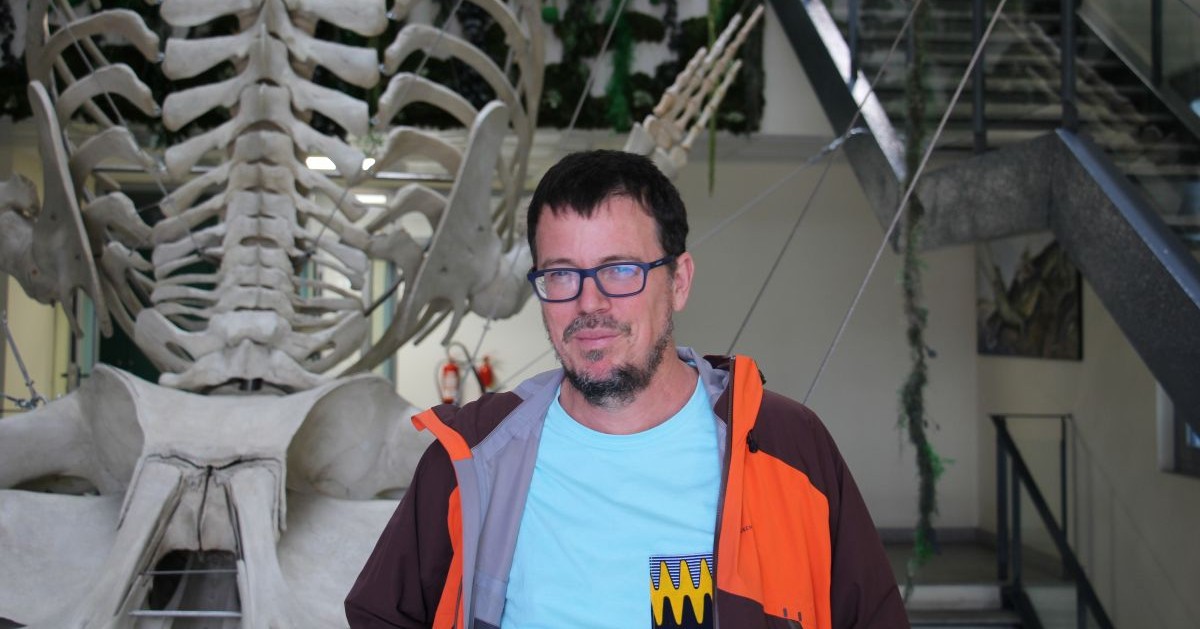
Miguel Clavero, senior scientist at the CSIC at the Doñana Biological Station. Credit: Fermín Grodira
From the Department of Conservation Biology at the Doñana Biological Station (EBD. in Spanish), a centre of the Spanish National Research Council (CSIC. in Spanish) based in Seville, the Seville-born biologist Miguel Clavero focuses his research activity on two areas. On the one hand, he investigates the biodiversity of inland waters, with a focus on eels and river crabs. On the other hand, he studies historical ecology, which shows how humans have interacted with our environment over time. This work has led him to discoveries such as the fact that the so-called Iberian freshwater crab was actually introduced from Italy by Philip II of Spain.
The recent announcement by the Ministry for the Ecological Transition and the Demographic Challenge to once again propose that the autonomous communities declare the eel endangered, with the aim of ensuring its recovery and halting its decline, shows the importance of the scientific community and its research in public policy. A study led by Clavero and other researchers from the EBD-CSIC published in 2025 in the scientific journal Conservation Letters concluded that the scarcity of the species itself, combined with the human desire to consume exclusive products, generates a market extinction vortex that encourages eels to be fished and commercialised until they disappear completely.
Question: What is the state of biodiversity conservation in Europe?
Answer: In Europe, processes are underway that have allowed for the recovery of part of the biodiversity, as has happened in part with some large carnivores and with the fauna and flora associated with forest masses, thanks to the economic development that has led to the cessation of the exploitation of many raw materials and allowed for the recovery of the forest. However, there are many groups that are in a very poor state of conservation, such as organisms associated with agricultural or open environments, which have been lost. In general, aquatic fauna is in a very poor state of conservation and is getting worse, especially river fish.
Q: Japanese and American eels are endangered and European eels are critically endangered, but they are still sold commercially. Why is this?
A: The threat category that the International Union for Conservation of Nature (IUCN) assigns to a species based on its status and trends has no legal implications. The European eel sustained the most important inland fishery in Europe. This has created inertia and a powerful lobby that has a strong influence on the decisions that should be taken: a ban on fishing and commercialisation. Administrations at all levels are very fearful of the unpopularity that such a decision could generate. However, the steps taken recently by the Ministry for the Ecological Transition and the Demographic Challenge seem very decisive and are encouraging.
Q: What are the main arguments for and against banning eel fishing?
A: The trend for European eels is very clear and is leading to their extinction. Analysis of global data led to them being considered critically endangered as early as 2008, and subsequent assessments have reached the same conclusion. A species on the brink of extinction should not be commercially exploited. Obviously, those who fish and sell eels feel the harmed party. But the role of the authorities should not be to ignore the scientific knowledge and adopt the arguments of these affected groups, but rather to offer solutions to these people. The authorities should include fishermen in eel monitoring programmes. Their participation and knowledge are important, and there are many ways to involve them in the desired recovery of the eel. But embracing scientific denialism in the hope of preserving an activity that will disappear anyway when there will be no more eels is doing a disservice to fishermen and society as a whole. Let’s hope that the authorities are up to the challenge as managers of the common good.
Q: Is it possible to breed eels in captivity?
A: A lot has been invested in this. The most progress has been made with Japanese eels, and the cycle has almost been completed. With European eels, it has been possible to reproduce the conditions in which they are supposed to reproduce, and even to breed individuals, but the cycle has not yet been completed. Even if this is achieved, there is no guarantee that the species will be conserved. The clearest example of this is the Atlantic salmon. It is a species in decline, with a tendency towards extinction in Spain, while at the same time it is one of the most commonly farmed fish in the world. It has a huge market and is produced in several countries, but captive breeding has not prevented the decline of natural populations. In any case, it is not yet on the horizon that eels can be produced cheaply in captivity to supply the markets, as is done with salmon. It is not commercially viable at the moment.
Q: How did elvers, the young of eels, become a luxury dish?
A: It is partially a myth that elvers were a dish for the poor. We know that they were a very abundant animal, which in many places was not exploited. In the Guadalquivir river, no one used elvers until the Basques came in the 1970s and paid for them. Before that, they were not exploited, and it would not be unusual for such an abundant resource to be used, as they say, to feed chickens and pigs. In the Basque Country, where the tradition of eating elvers began, they were a popular food. With the collapse of the eel population since around 1980, far fewer elvers are caught, and this scarcity has made them an expensive product. When a product becomes excessively expensive, it may be abandoned, but it may also be that the elites begin to see it as a sign of exclusivity. And the latter is what has happened with elvers. If the price increase trend continues, in theory it would be profitable to catch every last elver to sell them on the market for someone else to eat. This vicious cycle, which feeds back positively, is called a market extinction vortex and it would only stop if the authorities banned the elvers trade. If we let the market operate freely, it will lead to the extinction of the eel.
Q: What factors have caused the decline of the eel?
A: It is a multifactorial process. One cause is dams, which act as barriers. At the beginning of the 20th century, elvers reached almost all of Spain without any problems via waterways, even at altitudes above 1,000 metres above sea level. Now they are practically a coastal animal, because there are thousands of reservoirs blocking their access to many places. In Europe, with a much flatter terrain, elvers can still travel many kilometres inland. Another factor is the impact of a parasite from Asian eels, which was introduced into Europe through the global eel trade in the 1970s and 1980s. This parasite grows in the swim bladder and is believed to greatly limit the ability of eels to return to the Sargasso Sea, where they reproduce. Pollution also plays a role because it causes the eels to accumulate a lot of fat, which they need to return to the Sargasso Sea, a journey of at least 5,000 kilometres that they make without eating. This high amount of fat causes many pollutants to accumulate.
In addition, there is one of the main threats: fishing. The eel fishing lobby always wants to emphasise that it is a traditional, low-impact fishery, but the reality is that it is not so traditional. There is a traditional fishery that changed throughout the 20th century to become an industrial fishery and, moreover, became globalised. In the early 1970s, the Japanese eel, the most consumed Asian species in Japan, collapsed, and the Asian market began to pull in European eels, which also collapsed. The market then focused on American eels, which also collapsed. There is a sequential collapse, which has a very clear relationship with commercial exploitation.
Q: What remains to be discovered about the biology of eels?
A: There is still much to discover. Surprisingly, we still do not know where, how, or when European eels reproduce. The discovery that eels reproduce in the Sargasso Sea was made just over 100 years ago. Johannes Schmidt, a Danish biologist, devoted himself to collecting eel larvae throughout the Atlantic, measuring them with the idea that the smallest ones would be found where the species reproduced. He closed the circle, measuring thousands of leptocephalus larvae, which is the name given to this stage of eels, until he concentrated on an oval that he drew on a map and said that eels reproduce there. But that oval covers hundreds of thousands of square kilometres.
Since Schmidt's work, we have not really learned anything new about eel reproduction. Technological developments have made it possible to tag eels that were already migrating towards the Sargasso Sea, and all the results showed that the eels were heading towards the place Schmidt had marked. But we still do not know where they actually reproduce in such a large area, or at what depth, or at what time of year, or how many of the individuals that leave the area reproduce.
Q: Another focus of your research is invasive species, specifically invasions by crayfish, dating back even centuries. Why has there been such a long-standing interest in transporting crayfish from one place to another?
A: Different species of crayfish have been introduced in many places because humans like these animals. They are fun to catch in the countryside, and they are easy to eat and transport alive over long distances. In Spain, there was a very clear and straightforward story about the existence of a native crayfish, until the American species arrived and wiped out the native species. However, through our historical ecology work, we have shown that this supposedly native crayfish is actually also an introduced species, originating in Italy. We have found archive documents showing that the crayfish arrived in Spain in the 16th century, on the initiative of Philip II. The king had organised the landscaping of the Royal Sites, where ponds had been built, and he wanted to have the fish and crabs he had encountered on his travels through Europe. He spent 25 years trying to obtain crayfish until, in 1588, they were sent to him from the Grand Duchy of Tuscany. We have documents that not only show that they were sent, but that they arrived alive in Madrid.
Q: Were there no crayfish on the peninsula until the 16th century?
A: Until 1588, when the Italian crayfish arrived, there is no evidence that there were any crayfish on the peninsula. Of course, the Italian species, imported by Philip II, was not present in Spain. There are crayfish fossils in what is now the Iberian Peninsula, but they are hundreds of millions of years old, too long ago to establish any connection with today's crayfish.
Q: How long would it take for an introduced species such as the crayfish to be considered native? Or does it not work that way?
A: For me, it doesn't work that way, although it is true that there is debate in the scientific community on this issue. In my interpretation, an introduced species will never become native, because the fact of being introduced is a property of the species in the territory. All species are native to somewhere, but in a specific territory, a species is introduced if its presence there is due to active transport by humans. The Italian river crab is an introduced species on the Iberian Peninsula, because we know that it was brought by ship in 1588, and that characteristic will not be removed no matter how much time passes. Being an invasive species is different, as that classification has more to do with impact and often involves active management aimed at trying to eliminate or control it. Although the Italian crayfish was an invasive species, today it makes no sense to classify it as such, because its decline means that its impact on the environment is minimal and there is no point in taking action against it. The interesting discussion is whether it makes sense to take action in its favour.
Fermín Grodira / Content produced within the CSIC – BBVA Foundation Scientific Communication Grant Programme, Call 2024