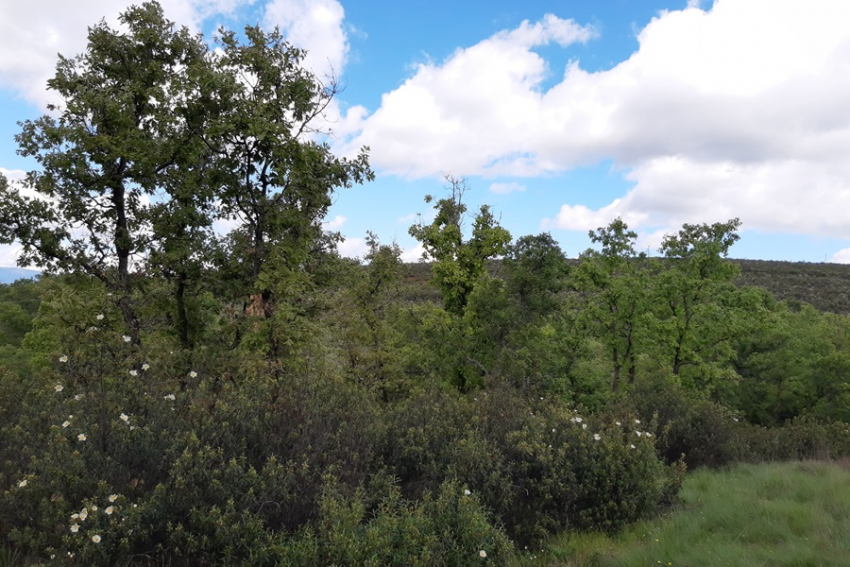
The study, led by the Global Change Research Institute of the Rey Juan Carlos University (IICG-URJC) and with participation of the Doñana Biological Station and other institutions, reveals that trees can act as mediators that balance competition between plants, preventing the strongest ones from eliminating the weakest.
Credit: Ezequiel Antorán Pilar
Why can plants that compete for the same resources grow in the same area without one eliminating the other? This question, which ecologists have been trying to answer for decades, has just received a surprising answer: the soil surrounding the oak trees acts as a silent mediator that restrains the most dominant ones and gives an advantage to the weaker ones, allowing both to coexist.
A team of researchers led by the Institute for Research on Global Change (IICG-URJC), reveals how Pyrenean oaks (Quercus Pyrenaica) modify the chemical and microbial composition of the surrounding soil, creating conditions different from those of the rest of the land. These conditions decrease the germination of the sticky rockrose (Cistus ladanifer), the dominant and most aggressive species, while favoring the growth of the steppe rockrose (Cistus laurifolius), the weaker one. The result: both coexist.
The study, recently published in the prestigious journal Ecology Letters, involved the collaboration of researchers Jaime Madrigal González (University of Valladolid), Rubén Bernardo Madrid (Doñana Biological Station-CSIC), Miguel Ángel Fernández Martínez (Autonomous University of Madrid), and Marcelino de la Cruz Rot (IICG-URJC). The University of Umeå (Sweden) also participated in this work.
A mediator in the shadows
The team designed experiments in which they cultivated seeds of both rockrose species in soil samples collected from near oak trees and compared them to soils without that influence. The results were clear: seeds of the dominant rockrose species germinated less successfully in oak-grown soil, while seedlings of the weaker rockrose species grew better in oak-grown soil. These effects are due both to the chemical substances that the oak accumulates in the soil (through its roots and the decomposition of its leaves) and to the specific microorganisms that live in that soil.
"It's as if the oak tree redistributes resources from below," explains Ezequiel Antorán. "Without it, the sticky rockrose ends up dominating and the steppe disappears. But with it in the way, there's room for both," adds the researcher from the IICG-URJC.
The theory coincides with nature To verify that these effects were sufficient to maintain long-term coexistence, the team developed computer simulations based on the experimental data. The models reproduced with remarkable accuracy the distribution patterns observed in nature: the weaker rockrose concentrates near the oak trees, while the dominant rockrose proliferates in distant areas. The simulations also showed that both populations remain stable for a hundred years.
"What makes this study special is that we not only explain the 'why' in the laboratory, but we also see it reflected in the field. That is the most difficult thing to achieve in ecology," notes Joaquin Calatayud.
Importance for the future of ecosystems
The finding has implications that extend far beyond the Central System, where the study was conducted. Understanding how indirect interactions between species maintain biodiversity is key to managing ecosystems, restoring degraded habitats, and predicting how plant communities will respond to climate change or species loss. If we remove ecosystem mediators—trees like oaks—we can unknowingly disrupt the balances that allow many other species to coexist.
"The result reinforces an increasingly important idea: biodiversity is not maintained solely by direct competition between species. It can also depend on indirect interactions. This broadens our understanding of coexistence: it is not enough to ask which species compete with each other, but also how some species modify the conditions that affect others," says Rubén Bernardo Madrid, a researcher at the Doñana Biological Station (EBD-CSIC).
This work has been funded by the Ministry of Science, Innovation and Universities and the Community of Madrid.
Reference:
Antorán, E., J. Madrigal-González, R. Bernardo-Madrid, M. Á. Fernández-Martínez, M. de la Cruz, and J. Calatayud. 2026. “Indirect Interactions Driven by Soil Effects Enable Coexistence Among Competing Plant Species.” Ecology Letters 29, no. 5: e70396. https://doi.org/10.1111/ele.70396 .