Carrion is a key source of scientific insight, helping us understand ecology, epidemics and human evolution.
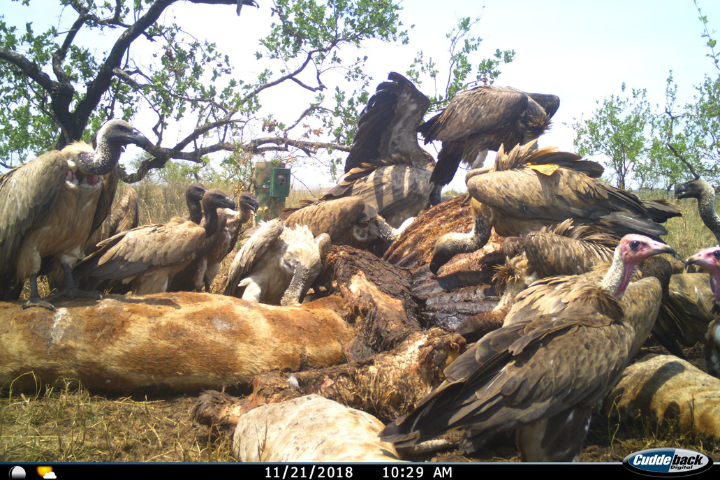
Animal carcasses are important hubs for the concentration and interaction of numerous carnivorous and omnivorous species, in this case African vultures, lappet-faced vultures, ravens and hyenas. Photo: M. Moleón.
What happens after death? An international study led by the University of Granada, with the participation of the Doñana Biological Station (EBD-CSIC), argues that this question, long overlooked by ecological sciences, helps explain numerous processes and provides new perspectives across different disciplines.
The study, published in the journal Biological Reviews and conducted by an international team of 39 scientists from eleven countries, synthesizes more than twenty years of advances in carrion ecology. It examines what science gains by incorporating carrion into its interpretation of nature, from individual animal behaviour to ecosystem functioning and the evolution of human beings themselves.
According to the research team, carrion has traditionally been regarded as a secondary resource consumed only by a few specific species, such as vultures and hyenas. However, recent studies show that it plays a much broader and more profound role.
“Animal carcasses create hotspots of nutrients, organisms and biological interactions that strongly influence the structure and functioning of both terrestrial and aquatic ecosystems,” explains Marcos Moleón, professor in the Department of Zoology at the University of Granada and a researcher involved in the study.
A New Perspective on Ecology
The review reveals that carrion makes it possible to reinterpret some fundamental concepts in ecology. For example, the authors show that there are numerous forms of cooperation and mutual facilitation that enable the coexistence of species competing for carrion.
They also highlight that carrion influences herbivore populations, contributes to ecosystem stability, and even establishes links with ecological networks as diverse as pollination systems through relationships that extend far beyond simply who eats whom.
In addition to being a nutritious food source, animal carcasses provide materials for nest building, tools and ornaments, serve as centres of information and communication among individuals of the same species, and their remains offer structures where numerous species can settle and find shelter.
“We are discovering that many ecological processes cannot be fully understood if the role of carrion is ignored,” explains Eneko Arrondo Floristán, a researcher at the University of Granada who coordinated the study together with Marcos Moleón. “For decades, research on carnivorous animals has focused primarily on their role as predators, but recognising that they can also be scavengers has far-reaching ecological consequences,” the scientists add.
From Public Health to Criminal Investigation
The review also shows that the implications of carrion extend well beyond ecology. In forensic science, detailed knowledge of decomposition processes improves estimates of the time elapsed since death. In epidemiology, understanding how different species use carcasses helps clarify the role of scavengers in reducing the spread of diseases. In toxicology, certain scavenger species serve as excellent sentinels of environmental pollution.
“Carrion ecology provides new tools for interpreting archaeological and fossil sites, understanding animal evolution, and re-evaluating hypotheses about meat consumption by early humans,” recalls Marcos Moleón.
It also offers new perspectives on analysing the social perception of carnivorous animals and the benefits that scavengers provided to human ancestors—and continue to provide to modern societies. In addition, this type of research offers new solutions to challenges related to biodiversity monitoring and conservation.
A Paradigm Shift
The study's main conclusion is that carrion should not be regarded as a marginal resource, but rather as a central component of ecosystems. Accordingly, the authors propose formally recognising carrion ecology as a distinct scientific discipline and present a conceptual framework that integrates its multiple ecological functions and its connections with other fields.
“The most important point is not simply that we know much more about carrion today than we did twenty years ago,” the authors note. “What is truly significant is that we are beginning to understand the extent to which incorporating carrion transforms our view of the natural world and can help answer fundamental questions that have until now remained only partially explained.”
Far from being merely a biological curiosity, carrion is emerging as a key element for improving our understanding of nature and for connecting disciplines that have long developed along separate paths.
Referencia:
Moleón M., Sánchez-Zapata, J. A., DeVault, T. L., Getz, W. M., Morales-Reyes, Z., Redondo-Gómez, D., Naves-Alegre, L., Batista-Nunes, S. A., Sebastián-González, E., Pérez-García, J. M., Waters, K. A., van Overveld, T., Smith, C., Selva, N., Schlacher, T. A., Ruxton, G., Rodríguez, J., Quaggiotto, M.-M., Perrig, P. L., Owen-Smith, N., Newsome, T. M., Navas, I., Nakashima, Y., Mateos, A., Martínez-Carrasco, C., Martín-Vega, D., Martín-López, B., Margalida, A., Lambertucci, S. A., Kane, A., Healy, K., Hashizume, A., García-Fernández, A. J., Donázar, J. A., Benbow, M. E., Beasley, J. C., Barton, P. S., Alexander, K. A., Eneko Arrondo, E. 2026. Carrion ecology: concepts, interdisciplinary synthesis, and perspectives. Biological Reviews. https://doi.org/10.1002/brv.70203.