Heat prevention plans reduced heat deaths in Europe by a quarter
In Spain, a country heavily affected by increasingly frequent and intense heatwaves, a 15% reduction in heat-related deaths has been detected
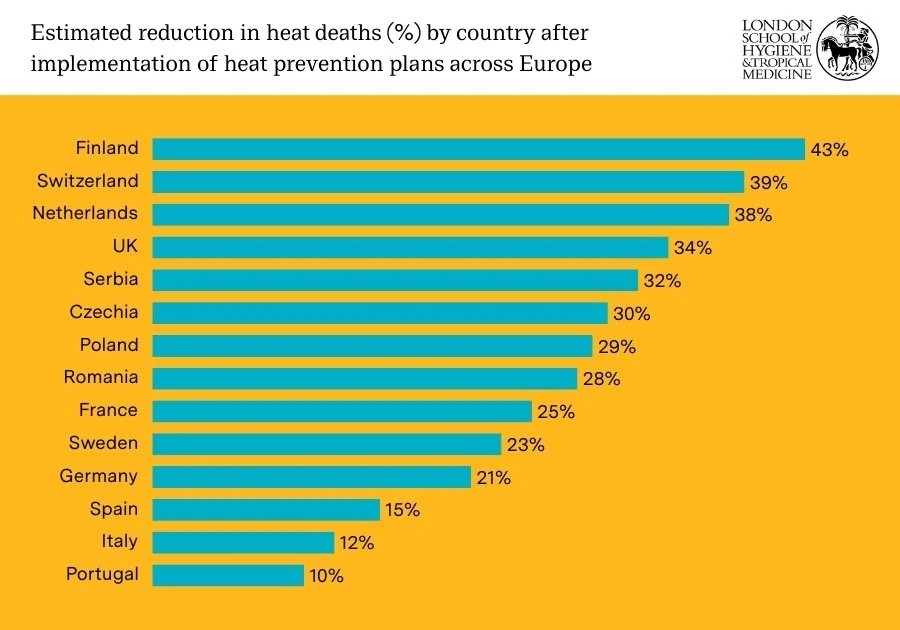
An international study with the participation of the Doñana Biological Station – CSIC concludes that the implementation of heat prevention plans in Europe has reduced deaths from extreme heat by 25%. The study has been published in the journal Environmental Research Letters and was led by the Czech University of Life Sciences (CZU) and the London School of Hygiene & Tropical Medicine (LSHTM).
“Our study, based on state-of-the-art methods and a large multi-country database, provides the strongest evidence so far about the effectiveness of heat prevention plans in reducing health impacts”, said Antonio Gasparrini, Professor of Biostatistics at LSHTM and senior author on the study.
To conduct the study, the research team analysed daily temperature and mortality data from 102 locations in 14 European countries from 1990-2019 to assess how heat-related mortality changed after the introduction of national and regional heat prevention plans. Heat prevention plans typically include early warning systems, public communication, protection of vulnerable populations and adaptations in healthcare services. In southern and western Europe, they were implemented mainly after the 2003 heatwave, while in northern and eastern Europe they were developed primarily in response to the 2010 heatwave.
After the implementation of these plans, it is estimated that deaths in Europe have fallen by a quarter overall. Of the 14 countries included, the largest relative reductions in heat-related mortality were observed in Finland, Switzerland, Netherlands and the UK. The least effective measures were found in Southern Europe, particularly Portugal, Italy and Spain.
In Spain, one of the countries most affected by heatwaves, the results indicate that the implementation of heat prevention plans has reduced mortality associated with extreme heat episodes by around 15%.
There is no simple explanation for the lower percentage observed in Southern European countries. “In Northern countries there is greater uncertainty, as we have fewer data. One possible explanation is that in hotter climates it is more difficult to implement effective adaptation measures than in colder climates,” explains Veronika Huber, co-author and researcher at the Doñana Biological Station. “The lower percentage we observe in Southern European countries could be an indication that in these countries, including Spain, we are already closer to the limits of adaptation.
“Our results provide clear evidence that heat prevention plans are effective public health tools. On average, we observed a reduction of more than 25% in excess mortality during extreme heat after these plans were implemented”, said Aleš Urban, lead author and Research Scientist at CZU.
The authors emphasise the public health relevance of these findings, showing that well-designed prevention measures can substantially reduce avoidable deaths during periods of extreme heat. The results provide evidence to inform future public health planning and support the integration of heat prevention into wider health protection strategies.
Dr Veronika Huber, co-author and researcher at the Spanish National Research Council (CSIC), said: “With climate change expected to increase the frequency and intensity of heatwaves, our findings highlight the importance of making heat prevention plans a core component of climate adaptation strategies across Europe.”
The researchers note that this study couldn’t highlight benefits from specific parts of heat prevention plans, such as knowing the specific impact of heat alerts. The methods also did not record reductions in morbidity (non-fatal medical problems using measures like hospitalisation data). Follow-up work from the researchers will analyse prevention plans in greater detail to plug these gaps of knowledge.
Dr Malcolm N Mistry, Assistant Professor at LSHTM and co-author on the paper, said: “While mitigation remains the priority to limit future global warming, our study demonstrates that adaptation through heat prevention plans is an important mechanism that can significantly buffer local populations against the lethal risks of heat on health.”
The study also examined the different characteristics included in prevention plans in each country. Contrary to what might be expected, no conclusive evidence was found that more developed plans provided greater protection.
Further research may identify the specific benefits of individual components of the plans, such as the precise impact of heat alerts, as well as conduct in-depth analyses of potential reductions in morbidity (non-fatal health outcomes, such as hospitalisations).
This research was based on international collaboration with experts from the MCC Collaborative Research Network, COST Action PROCLIAS, and HORIZON EU project CROSSEU.
Aleš Urban, Veronika Huber, Salomé Henry, Nuria Pilar Plaza, Lucie Tušlová, Shouro Dasgupta, Pierre Masselot, Ivana Cvijanovic, Malcolm Mistry, Mathilde Pascal, Francesca de’Donato, Claudia Di Napoli, Simon N Gosling, Silvia Kohnová, Jan Kyselý, Samuel Lüthi, Louis-François Pau, Martina S Ragettli, Reija Ruuhela, Niilo Ryti, Susana Das Neves Pereira da Silva, Shiri Zemah-Shamir, Wim Thiery, Ana-Maria Vicedo-Cabrera, Joanna Wieczorek, Francesco Sera, Ben Armstrong, Antonio Gasparrini. The effectiveness of heat prevention plans in reducing heat-erlated mortality across Europe. Environmental Research. https://doi.org/10.1088/1748-9326/ae2775