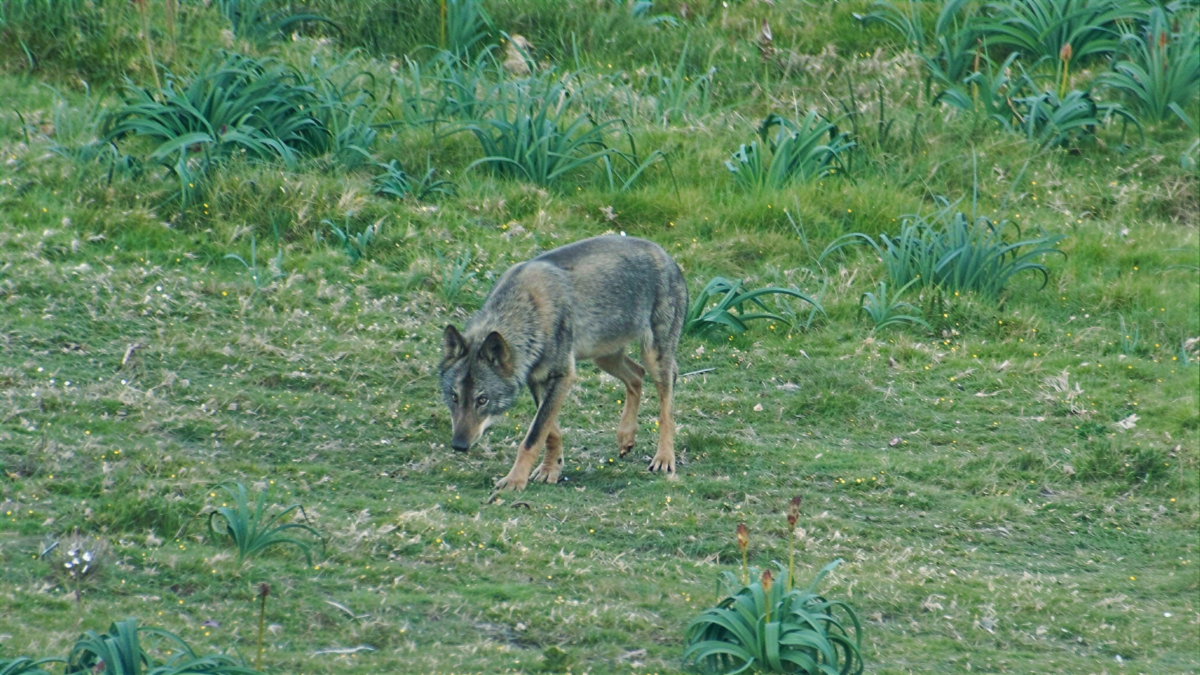
A study led by the Doñana Biological Station (EBD-CSIC) and the University of A Coruña analyzes the factors that shape Iberian wolf movement. High human population, settlements and roads are the main factors limiting their movements. Vegetation acts as a buffer, providing refuge from these negative effects.
Iberian wolf. Credit: Francisco Javier Lema Fuentes.
A scientific study led by the Doñana Biological Station (EBD-CSIC) and the University of A Coruña reveals that Iberian wolves living in human-dominated environments significantly restrict their daily movements. The research, published in Behavioral Ecology, offers a comprehensive view of how large carnivores adapt their movements in human-shaped landscapes. The study also involved researchers from the National Museum of Natural Sciences (MNCN-CSIC), the Joint Institute for Biodiversity Research (IMIB-CSIC), and the University of A Coruña, among others.
“Wolves have traditionally been described as highly mobile predators, capable of traveling long distances in search of food. However, this study shows that they alter this mobility in landscapes with a strong human presence,” explains Iago Ferreiro Arias, a predoctoral researcher at the Doñana Biological Station and lead author of the paper.
Human disturbance as a key factor
The research team analyzed how different factors interact to determine wolves’ daily movement patterns. To do so, they studied the daily movements of 26 wolves in Galicia, one of the most humanized regions within the species’ range.
The results confirm that human disturbance is the main factor shaping wolf movement. In particular, high population density, the presence of human settlements, and infrastructure such as roads act as major barriers that restrict their movements.
In highly humanized landscapes, Iberian wolves significantly reduce their daily movement, averaging just 9 kilometers per day, with a net displacement from their starting point of only 3.8 kilometers. These figures represent a clear reduction compared to populations living in more natural environments.
However, this reduction is not driven by a single factor but by a complex interaction of multiple variables. Vegetation availability and structure can act as refuge and partially buffer these negative effects. Prey type also plays a role, although more subtly: wolves that feed mainly on livestock travel significantly shorter distances than those relying on wild prey. Intrinsic factors, such as whether wolves belong to a pack or are solitary, have a more secondary influence. Solitary wolves tend to travel longer distances, especially during certain reproductive periods.
“Our data suggest that in human-dominated environments, wolves adopt a risk-minimization strategy,” says Iago Ferreiro Arias. “They drastically shorten their movements to reduce exposure to human disturbance, as long as food and protective vegetation are available nearby.”
¿Adaptation or simple response?
Until now, most studies on wolf movement have focused on more natural settings, where wolves roam widely in search of wild prey and human influence is limited. In these contexts, factors such as prey availability or social status have typically been studied in isolation. While this has helped explain specific mechanisms, it has not provided an integrated view of how these factors interact simultaneously or their relative importance. One of the study’s main contributions is precisely its holistic approach, jointly evaluating environmental and intrinsic variables.
“A key question that remains open is whether this reduction in movement translates into greater survival or reproductive success,” says Ferreiro. “Exploring this link would help determine whether these responses are true behavioral adaptations to the environment or simply short-term reactions that may carry long-term costs.”
The study also shows that not only the amount of vegetation cover but also its spatial configuration influences movement. Future research should further explore how vegetation structure and other landscape features facilitate movement and connectivity between populations, ultimately supporting genetic diversity.
These findings highlight that coexistence between wolves and humans depends not only on the presence of the species but also on how the shared landscape is organized.
Referencia
Ferreiro Arias, I., Martínez Rueda, I., García, E. J., Palacios Sánchez, V., Sazatornil, V., Rodríguez, A., López-Bao, J. V., & Llaneza, L. (2026). Human disturbance, prey availability and refuge cover shape wolf movements in anthropized landscapes. Behavioral Ecology. https://doi.org/10.1093/beheco/arag037