Invertebrates turn large-scale fish die-offs into a resource for terrestrial vertebrates
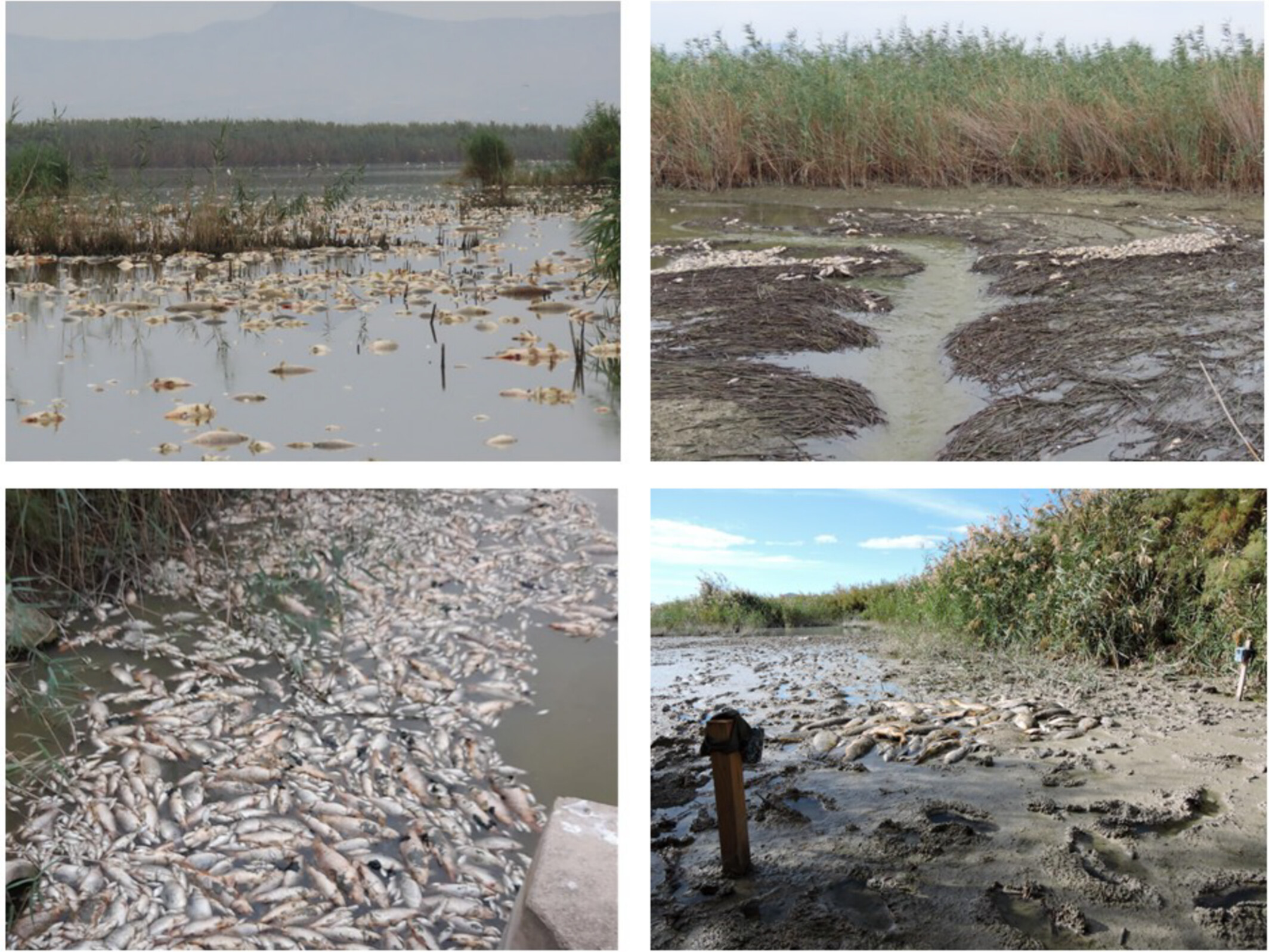
Mass fish mortality events trigger a process of energy transfer from the aquatic environment to the terrestrial environment.
An international study led by the University Miguel Hernández (UMH) in Spain, with the participation of the Doñana Biological Station (EBD-CSIC) and other institutions, shows that invertebrates act as intermediaries in the transfer of energy from dead fish to birds and other vertebrates. The research, published in the journal Freshwater Biology, was conducted in El Hondo Natural Park in Alicante (Spain) and shows that the energy contained in dead fish does not reach terrestrial vertebrates only through the direct consumption of carrion. Rather, an important part is transferred via the invertebrates that colonize the carcasses and that are subsequently consumed later by birds and other vertebrates.
The article offers a novel, integrated analisis of the vertebrates and invertebrates communities associated with large accumulations of dead fish and how these communities change throughout the decomposition process. The study was conducted in the context of common carp (Cyprinus carpio) die-offs that occur in El Hondo during certain management actions targeting this invasive species.
Mass animal die-offs generate enormous amount of biomass in a short period of time.These events can be caused by phenomena such as droughts, extreme temperatures or oxygen deprivation, and are becoming increasingly significant in a context of global change. However, while a numerous studies have examined what happens around an individual carcase, little is known about how animal communities respond when large amount of carrion accumulate in a single location.
Carrion attracts a community of invertebrates that serve as food for many species
To study this phenomenon, the scientific team monitored 20 carp accumulations, with an average biomass of approximately 110 kilograms per accumulation, during 35 days. The researchers used trap cameras to record vertebrate activity and conducted periodic sampling of the invertebrates present on the carcasses. In total, they identified 35 vertebrate taxa and 20 groups of invertebrates associated with these accumulations.
One of study’s main findings is that most of vertebrates recorded did not directly feed on fish. The 60% of vertebrate taxa fed exclusively on invertebrates associated with the carrion, while only 11,4% consumed the dead fish exclusively. Another 28,6% combined both types of feeding. Among the species that fed on invertebrates, numerous small insectivores’ passerines were numerous, as well as other birds and some mammals. At the same time, the carp carcasses were colonized by a large number of invertebrates. The researchers estimated more on 200.000 individuals across all accumulations studied. Dipteran larvae were the most abundant group, followed by the dermestid larvae.
The study also shows that the relative importance of different consumers changes as the carcasses decompose. Vertebrates that directly consumed the fish tended to be more abundant during the early stages, while the those that fed on invertebrates present on the carcasses increased over time. This pattern coincided with the changes in the invertebrate community, whose abundance initially increased and then decreased as decomposition progressed.
Large fish die-offs, hotspots of interactions in the trophic network
According to the researchers, “the results show that a large accumulation of dead fish is not simply a food source for animals that feed on carrion. These carcasses support a invertebrate community which, in turn, becomes food for other vertebrates”. In this way, invertebrates can act as intermediaries between aquatic and terrestrial ecosystems, enabling some of the energy from the dead fish to reach animals that live and feed on land. The study thus suggest that the large-scale fish kills can function as hotspots of trophic activity in wetlands, with interactions among different groups of organisms and across different levels in the trophic network.
The significance of this phenomenon become particularly significant as episodes of mass mortality associated with global change increase. The researchers point out that understanding how these large pulses of biomass are incorporated into trophic networks will provide greater insight into the potential consequences for community structures, biodiversity and ecosystem functioning.
The study is led by Tatiana Pessano Serrat, a researcher at the UMH’s Center for Agri-Food and Agro-Environmental Research and Innovation (CIAGRO), and José Antonio Sánchez Zapata, with the participation of researchers Esther Sebastián González and Adrián Orihuela Torres from the University of Alicante, the latter of whom is also affiliated with the Doñana Biological Station (EBD-CSIC). The research is funded by the Spanish National Research Agency (RYC2019-027216-I and CNS2023-144791
Referencia científica:
Pessano-Serrat, T., E. Sebastián-González, J. A. Sánchez-Zapata, and A. Orihuela-Torres. 2026. Fish Mass Mortality Events Trigger Energy Transfer via Invertebrate-Mediated Pathways at the Aquatic–Terrestrial Interface, Freshwater Biology 71, no. 9: e70305. https://doi.org/10.1111/fwb.70305.