The Atlantic blue crab shows a great trophic flexibility and connects marine, brackish and freshwater ecosystems. In brackish areas, where it coexists with the red swamp crayfish, the crayfish occupies a considerably narrower trophic niche that overlaps with that of the blue crab. At the river mouth, the trophic niches of the different native crab species do not appear to overlap with that of the blue crab.
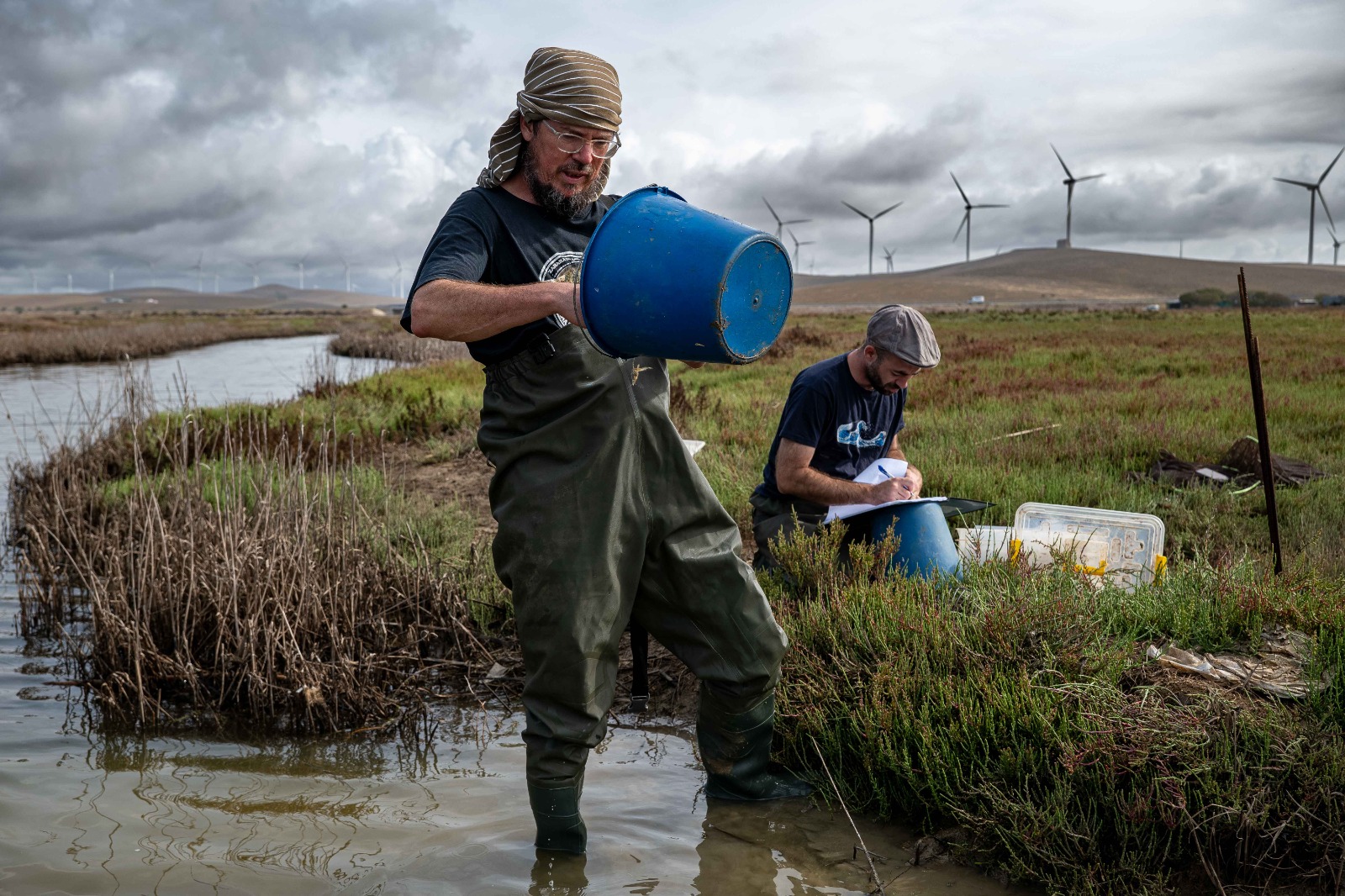
Researchers Miguel Clavero and Sergio Bedmar at the Cachón River, in Zahara de los Atunes (Southwestern Spain), during a sampling survey. Credit: Javier Esquivias.
En Within barely three kilometers of the Cachón River in Zahara de los Atunes in southwestern Spain, five crab species coexist—three native and two invasive—competing for and sharing the resources of this small Andalusian estuary. Now, a team from the Doñana Biological Station (EBD-CSIC) has studied how these species use trophic resources along the estuary.
Three native brachyuran crab species (or “true crabs”) live at the mouth of the estuary: the green crab (Carcinus maenas), the fiddler crab (Afruca tangeri), and the marbled crab (Pachygrapsus marmoratus), which share habitat with the blue crab (Callinectes sapidus), an invasive and highly abundant species. Further upstream, in the freshwater zone, another invasive crustacean dominates—the red swamp crayfish (Procambarus clarkii), belonging to the cambarid family (freshwater crayfish native to the American continent). Both invasive species overlap in the brackish middle section of the estuary.
To understand how these species feed and interact with one another, the team analyzed stable isotopes of carbon, nitrogen, and sulfur in the muscle tissue of 160 individuals. This allowed researchers to reconstruct the origin of the resources assimilated by each species, determine their trophic positions, and assess the degree of overlap between their niches.
The results show that the blue crab has the broadest trophic niche in the entire community, especially in the brackish zone, where it incorporates resources of both coastal and riverine origin. Furthermore, the findings illustrate how the blue crab, by moving through marine, brackish, and freshwater environments throughout its life cycle, can connect food webs across these ecosystems.
Likewise, near the estuary mouth, the trophic niches of native crabs do not appear to overlap with that of the blue crab, although a significant overlap was observed between the niches of the green crab and the fiddler crab.
The trophic niche of the red swamp crayfish is almost completely overlapped by that of the blue crab—but not the other way around—suggesting the existence of an asymmetric interaction that could negatively affect the red swamp crayfish invasion where both species coexist.
On the other hand, both the blue crab and the red swamp crayfish show important dietary changes throughout their lives, meaning that evaluating the impact of these species requires taking their different developmental stages into account. For example, the crayfish niche indicated a dietary shift toward greater consumption of plants and detritus in adults, but showed a less variable diet than that of the blue crab across different life stages.
Reference:
Sergio Bedmar, Francisco J. Oficialdegui, Manuela G. Forero & Miguel Clavero. Isotopic niches of native and invasive large decapods along a steep estuarine gradient. Biological Invasions. https://doi.org/10.1007/s10530-026-03833-3