New study identifies priority areas for Iberian arthropod conservation
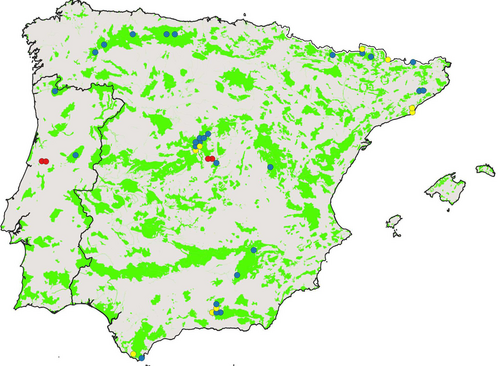
Priority areas for Iberobalear arthropods (Priority Areas for Iberobalear Arthropods [PAIA], i.e., cells that are hotspots for at least three taxonomic groups (see Figure 3). PAIA protected by N2000 network (>50%) are represented in blue, PAIA marginally represented in Natura 2000 (1%–50%) in yellow and those PAIA outside the Natura Network 2000 (<1%) in red. The Natura 2000 network is represented in green.
A scientific team with participation from the Doñana Biological Station – CSIC has identified for the first time the main priority areas for arthropod conservation on the Iberian Peninsula and the Balearic Islands. This represents the first large-scale integrative analysis of arthropod distribution in the region. The study highlights the key role of Iberian mountain systems as biodiversity refuges and assesses the effectiveness of the Natura 2000 network in protecting this essential group of organisms.
Arthropods, such as insects, spiders, and crustaceans, make up the majority of the planet’s biodiversity and perform essential ecosystem functions, yet they remain a largely overlooked group in conservation policies. To address this gap, the research team created a database containing distribution records for a total of 6,231 species belonging to 13 major arthropod taxonomic groups across the Iberian Peninsula and the Balearic Islands.
Thanks to this collaborative effort, 40 priority areas for arthropod conservation were identified in these regions, concentrating an exceptional richness of species. Most of these areas are located in major mountain systems such as Sierra Nevada, the Pyrenees, and the Cantabrian Mountains, which serve as key refuges for Mediterranean biodiversity.
Additionally, the study evaluates the effectiveness of the European network of protected areas, Natura 2000. The results show that protected areas within the Natura 2000 network cover much of these priority zones, although some important areas remain insufficiently protected. This finding reinforces the network’s role in European biodiversity conservation, despite arthropods not yet being explicitly considered in its designation.
The results, published in the scientific journal Insect Conservation and Diversity, emphasize the urgent need to explicitly integrate arthropods into management and conservation plans for protected areas and provide a solid foundation to guide future strategies within the post-2020 Global Biodiversity Framework.
Reference:
Sánchez-Fernández, D., Mañas-Jordá, S., García-Meseguer, A.J., Acosta, R., Ariño, A., Baquero, E. et al. (2026) Priority areas for arthropod conservation in the Iberian Peninsula and Balearic Islands: Insights from a multi-taxon distributional database. Insect Conservation and Diversity, 1–12. https://doi.org/10.1111/icad.70060
This study is dedicated to the memory of Enrique García-Barros, who actively participated in this work and sadly passed away in January 2026.