02 June 2026
Ninety-year tends reveal sharpest insect declines in the mid-twentieth century
An international study conducted in Switzerland, with participation of the Doñana Biological Station (EBD-CSIC) reveals how the diversity of several insect groups has changed during the last 90 years.
Butterflies and deadwood beetles experienced steep declines between 1950 and 1980 due to agricultural intensification and landscape homogenization
Butterflies and deadwood beetles experienced steep declines between 1950 and 1980 due to agricultural intensification and landscape homogenization
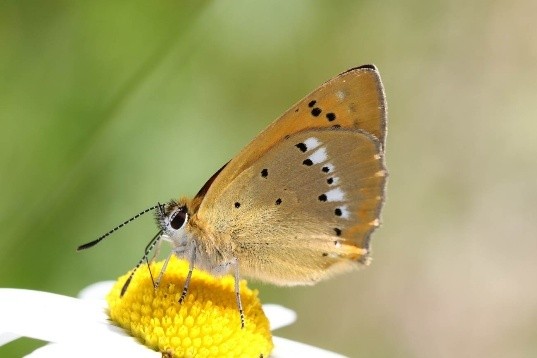
In the Swiss Plateau, the butterfly Lycaena virgaureae, whose caterpillar feeds exclusively on sorrel, has disappeared. In other regions, the population is stable. (Photo: Felix Neff)
An international research team with participation of the Doñana Biological Station (EBD-CSIC) has reconstructed nearly a century of changes in the diversity of several insect groups for the first time. Published in Nature Ecology & Evolution, the study shows that butterflies and deadwood beetles have experienced severe declines, particularly during the mid-20th century, coinciding with agricultural intensification, mechanization, and landscape simplification. Although the study focuses on Switzerland, the results help explain the impacts of these processes on biodiversity across other European countries, including Spain.
The study was led by Agroscope as part of the INSECT research programme and is based on historical and contemporary records of more than 800 species of butterflies and saproxylic beetles collected in Switzerland between 1930 and 2021. The data come from museum collections, scientific projects, monitoring programmes, and observations made by citizen scientists and naturalists, enabling researchers to reconstruct biodiversity trends spanning more than 90 years.
“People have always been fascinated by large insects such as butterflies and beetles. Consequently, there are numerous historical specimens, as well as reports in modern observation apps,” says Felix Neff of Agroscope, first author of the study.
Mariposas y escarabajos, respuestas diferentes al cambio ambiental
Butterflies and beetles, different responses to environmental changes
The results reveal that deadwood beetles declined until around 1960, after which their populations stabilized and, in some areas, recovered to levels comparable to those recorded in 1930. Butterflies, by contrast, continued to decline until the 1980s and have not fully recovered. On average, butterfly species richness is now 12% lower than it was in 1930, with the most pronounced losses occurring in regions characterized by intensive agriculture and urban development.
According to the study, the most severe declines occurred during the period of agricultural intensification between 1950 and 1980, marked by increased mechanization, landscape homogenization, and widespread use of fertilizers and pesticides. In forests, timber-oriented management practices and the removal of old trees and deadwood reduced habitat availability for many specialized beetle species.
“Most butterflies depend on sunny open land rich in nutritional sources, and many deadwood beetles on old and deadwood stands. These two groups are therefore representative of the condition of these habitats, on which many other species depend,” says Kurt Bollmann of the Swiss Federal Institute for Forest, Snow and Landscape Research (WSL), who co-initiated the INSECT research programme.
Signs of recovery thanks to conservation measures
The study also provides evidence of partial recovery. Forest conservation policies, the establishment of areas with deadwood and mature forests, and certain agri-environmental measures appear to have benefited some insect groups in recent decades. In addition, climate warming has favoured some species adapted to higher temperatures, particularly among wood-dependent beetles.
“The partial recovery in species numbers suggests that conservation measures are having an effect, particularly in forests, and that climate change is having a positive impact on some species,” says Bollmann. “However, more intensive efforts are still needed for numerous specialised species, like many butterflies.”
“This study shows that insect communities do not all respond in the same way: some species can recover when habitat conditions improve, but many specialists continue to decline or have failed to regain their historical levels,” says Carlos Martínez-Núñez, researcher at the Doñana Biological Station and co-author of the study. “The conservation message is clear: it is not enough to halt biodiversity loss. We need to restore habitat quality and heterogeneity, reduce pressures on agricultural landscapes, and preserve key features such as flowering resources, semi-natural field margins, old trees, and deadwood.”
The findings highlight the importance of conserving both flower-rich open habitats, which are essential for many butterflies and pollinators, and mature forests with sufficient deadwood, which are crucial for numerous beetles and other forest organisms. Insects perform vital ecological functions, including pollination, nutrient cycling, biological pest control, and the maintenance of food webs. Their decline can trigger cascading effects on ecosystem functioning and on the benefits that ecosystems provide to society.