23 March 2026
Wildlife consumption in Equatorial Guinea now impacts far more threatened species than 35 years ago
A study led by the Spanish National Research Council (CSIC) reveals a worrying increase in pangolins and other protected vertebrates in urban markets and rural areas destined for human consumption.
Threatened species are reaching higher prices, a factor that could further intensify the pressure on their populations.
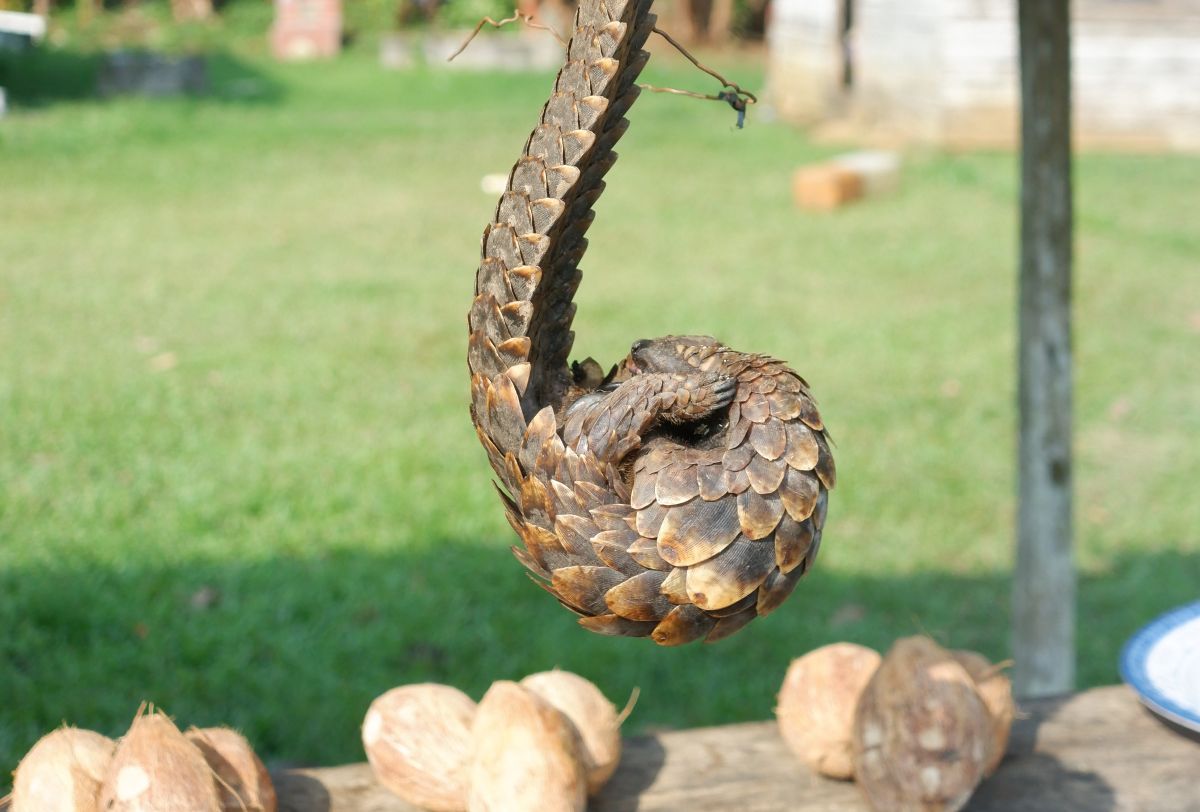
Pangolin displayed for sale. Credit: Pedro Romero-Vidal
A scientific team from the Spanish National Research Council (CSIC) has confirmed that wildlife hunting and trade in Equatorial Guinea currently involves far more threatened species than three decades ago. The study, published in the journal Biological Conservation, highlights a significant decline in the conservation status of species commercialized since 1990. The research was led by personnel from the Doñana Biological Station (EBD-CSIC) and the National Museum of Natural Sciences (MNCN-CSIC), in collaboration with local institutions.
More threatened species in markets than three decades ago
To conduct the study, the scientific team traveled to Equatorial Guinea and spent three months surveying the country's main wildlife sale points. Between January and March 2025, they visited the most prominent markets: the Malabo market, located on Bioko Island, and the Bata market, in the continental region. Additionally, they traveled through rural areas across the country—both on foot and by car—to record all wild animals being offered for sale along roadsides and in the streets of small towns.
In total, the team recorded 2,783 individuals belonging to at least 56 species of terrestrial vertebrates. The vast majority of the animals—94.2% to be precise—were offered for meat consumption, while the remainder were intended for medicinal or ritual uses (4.4%) and, to a lesser extent, the pet trade (1.4%).
Mammals accounted for 80% of the recorded individuals, followed by reptiles at 14.1% and birds at 5.9%. Many were sold fresh or even alive, reflecting the existence of an efficient and continuous transport network from hunting grounds to markets.
In 1990, only two of the species recorded in the markets were classified as globally threatened. Today, the situation is starkly different: the study documents 15 threatened species and 8 near-threatened species. Together, these species represent 41% of all recorded species and 21% of the total individuals counted.
Among them are the forest elephant, the western gorilla, the chimpanzee, several species of pangolins, and the African grey parrot. “The most concerning factor is not just the volume of commercialized wildlife, but the deterioration in the conservation status of the species involved,” says Pedro Romero Vidal, researcher at the Doñana Biological Station (EBD-CSIC).
The surge in pangolin trade
One of the most striking findings is the increase of pangolins in the trade. These scale-covered mammals, found in Africa and Asia, are among the animals most affected by hunting and illegal trade, and all their species are currently threatened. In 1990, they represented less than 2% of the individuals sold in urban markets. By 2025, they have reached 6.5% in Bata and 10.7% in Malabo.
Furthermore, in continental rural areas, the proportion of pangolins offered for sale is four times higher than that recorded in the Bata urban market, suggesting significant local consumption or trade that is not always reflected in the main markets.
The study also provides key insights into changes in the composition of commercialized species. Compared to 35 years ago, relatively fewer primates and large ungulates are sold today, while more reptiles, birds, carnivores, and pangolins are being traded. This could indicate that populations of some traditionally hunted species have declined, or that their hunting is more strictly prosecuted by local authorities, leading to their replacement by other more readily available species.
Higher prices for threatened species
On the other hand, economic analysis reveals that prices in the Bata urban market are, on average, double those in rural areas. Furthermore, threatened species fetch significantly higher prices, regardless of their frequency in the market. Compared to data from 2003, the prices of several species have more than doubled in two decades, with even greater increases seen in threatened species.
“The higher prices for threatened species suggest they are becoming scarcer or more highly valued, which may further increase the pressure on them,” explains José Luis Tella, a researcher at the Doñana Biological Station (EBD-CSIC).
Population growth, the expansion of the road network, and access to firearms have transformed hunting dynamics in the country, facilitating the daily transport of fresh animals from remote areas to urban markets.
Although national legislation prohibits the hunting of several threatened species, they continue to be sold openly in markets and along roadsides, highlighting deficiencies in the enforcement of regulations.
The scientific team emphasizes that, in addition to improving surveillance, educational campaigns aimed at reducing the demand for meat from threatened species are necessary, as well as strategies tailored to different social and cultural groups. They also highlight the importance of promoting affordable food alternatives.
“While some abundant species might withstand a certain level of exploitation, the continued hunting of primates, pangolins, and large mammals raises serious doubts about its sustainability,” concludes Íñigo Palacios-Martínez, from the National Museum of Natural Sciences (MNCN-CSIC).
Reference: José L. Tella, Íñigo Palacios-Martínez, Pedro Romero-Vidal, Guillermo Blanco, Javier Juste. Wildlife consumption is widespread across Equatorial Guinea and hunted species are more threatened now than 35 years ago. Biological Conservation. https://doi.org/10.1016/j.biocon.2026.111775