The new BMS Spain report provides further evidence of the decline of butterflies and their habitats.
ICTS-Doñana contributes to BMS Spain with data collected through standardised sampling protocols carried out in the Doñana Natural Area.
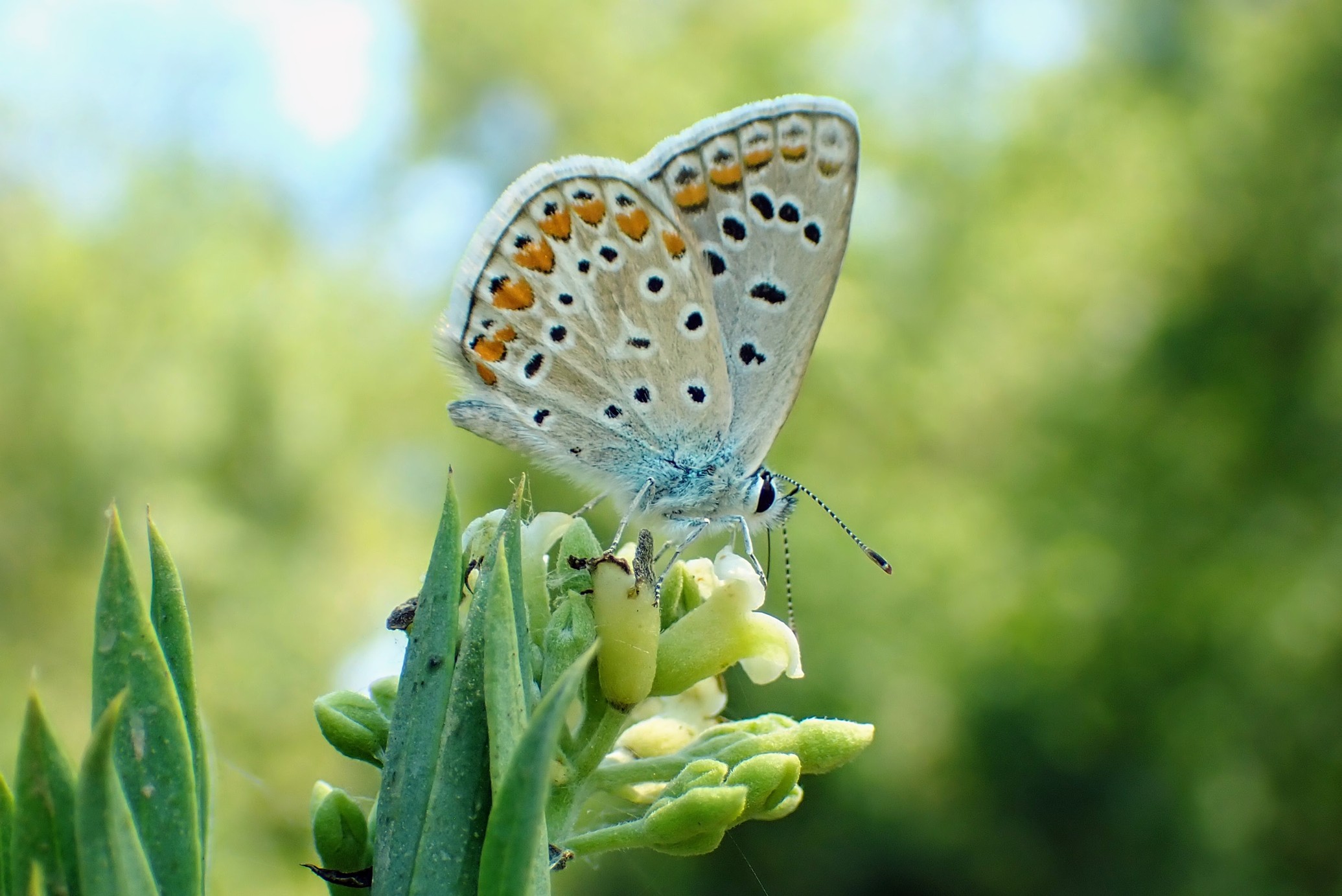
Southern blue (Polyommatus celina) feeding on a spurge flax flower (Daphne gnidium) (Photo: J. Manuel Vidal-Cordero).
The 2025 annual report of the Spanish Butterfly Monitoring Scheme (BMS Spain) provides a detailed snapshot of the state of these insects and the changes affecting their habitats. With record levels of participation and geographical coverage, the findings highlight several worrying trends, including the rising number of threatened species in Europe, the decline of specialist species and the increasingly evident effects of climate change on butterflies and their habitats.
BMS Spain (Butterfly Monitoring Scheme Spain) is a butterfly monitoring programme launched in 2014 to assess the conservation status of species and their habitats. It is currently coordinated by the Spanish Society for the Conservation and Study of Butterflies (SOCEME) and involves hundreds of volunteers and partner organisations, including the Doñana Biological Station, which contributes data collected by the ICTS-Doñana environmental monitoring area in the Doñana Natural Area.
Wildfires and climate change leave their mark
The report highlights that the 2025 season was marked by an intense heatwave and a series of major wildfires that affected numerous natural areas across Spain. According to the report, at least 37 BMS Spain transects were located within five kilometres of burned areas, while several routes were directly affected by fire. The data collected before and after the fires will make it possible to study their impact on the butterfly communities inhabiting these now-burned habitats.
The data also reveal worrying spatial patterns across different bioclimatic regions. While some regions maintain relatively stable abundance levels, transects in the southern Mediterranean sector show the most negative trends, with declines associated with increasingly extreme climatic conditions and habitat degradation.
At European level, the findings are consistent with those of the European Grassland Butterfly Indicator, which estimates that populations of grassland butterflies have declined by almost 50% since 1991, placing them among the groups of organisms most severely affected by land-use change, agricultural intensification and climate warming.
More threatened species and less habitat available
The report also warns of the deteriorating conservation status of butterflies in Europe. It highlights the 2025 update of the European Red List of Butterflies, which recorded a 76% increase in the number of threatened species compared with the previous assessment, from 37 to 65 species.
In Spain, BMS Spain recorded eight species classified as being at a high level of threat. Among them are the Iberian endemics Polyommatus golgus and Euchloe bazae, both classified as “Endangered”, of which only 23 and one individual, respectively, were recorded during the monitoring season. There were also few records of other threatened taxa such as Pieris cheiranthi, Gonepteryx cleobule and Erebia epistygne.
The situation of Pseudochazara williamsi is of particular concern. It is one of only six butterflies classified as “Critically Endangered” in Europe and the only Spanish species in this category. Recent studies show that the species has disappeared from a large part of its historical range and has lost more than 90% of its potential habitat.
A constantly expanding citizen science network
The expansion of BMS Spain confirms the programme’s consolidation as one of the country’s leading citizen science initiatives for monitoring biodiversity.
During the 2025 season, nearly 3,000 visits were made to 252 active transects across 36 provinces and 13 autonomous communities. The addition of 55 new transects, the highest number since the programme was established in 2014, significantly expanded geographical coverage and enabled monitoring to begin in provinces where no transects had previously been established, including Murcia, Almería, Burgos and Jaén. The expansion of BMS Spain confirms the programme’s consolidation as one of the country’s leading citizen science initiatives for monitoring biodiversity.
Overall, the network recorded more than 160,000 individual butterflies in 2025, 14% more than the previous year. The transects—fixed routes surveyed at regular intervals—identified 196 butterfly species, equivalent to 76% of the species found in Spain. A total of 21 endemic species were also recorded, including 16 found exclusively on the Iberian Peninsula and five in the Canary Islands. The most frequently recorded endemic species was Polyommatus celina, while the highest species richness was once again found in inland provinces with mid-altitude mountain habitats, such as Soria, Cuenca and Teruel, as well as in mountain systems including the Pyrenees, the Cantabrian Mountains and Sierra Nevada.
In addition to butterflies, the programme also collects data on other insect groups, with more than 2,000 moth records and 1,000 dragonfly and damselfly records. The 15-minute counts, which use the same methodology as the transects, provided information on just over 67,000 butterflies belonging to 313 different species.
An essential conservation tool
The Spanish network is part of the European Butterfly Monitoring Scheme (eBMS) and contributes to the development of indicators used by the European Environment Agency and in European Union conservation policies.
The information generated by BMS Spain is essential for understanding how insect populations change over the long term and for designing conservation strategies based on scientific evidence.
Members of the ICTS-Doñana terrestrial and aquatic systems team carrying out a butterfly survey in the Doñana Natural Area as part of BMS Spain (Photo: Juan Rayos).
References
Sevilleja, C. G., Gallego Zamorano, J., Barea Azcón, J. M., Montiel, C., de Arce Crespo, J. I., González, S., et al. (2026). 2025 Annual Report of the BMS Spain Butterfly Monitoring Programme. SOCEME. [BMS 2025 Report | PDF]
European Grassland Butterfly Indicator: https://www.eea.europa.eu/en/analysis/indicators/grassland-butterfly-index-in-europe-1