A study by the Doñana Biological Station (EBD-CSIC), published in PNAS, has identified what appears to be the depiction of a noctule bat capturing a bird in a painting by Jan Brueghel the Elder, more than four centuries before this behaviour was scientifically confirmed. These findings highlight the scientific value of historical works of art as a source of information on past biodiversity and the historical understanding of the natural world.
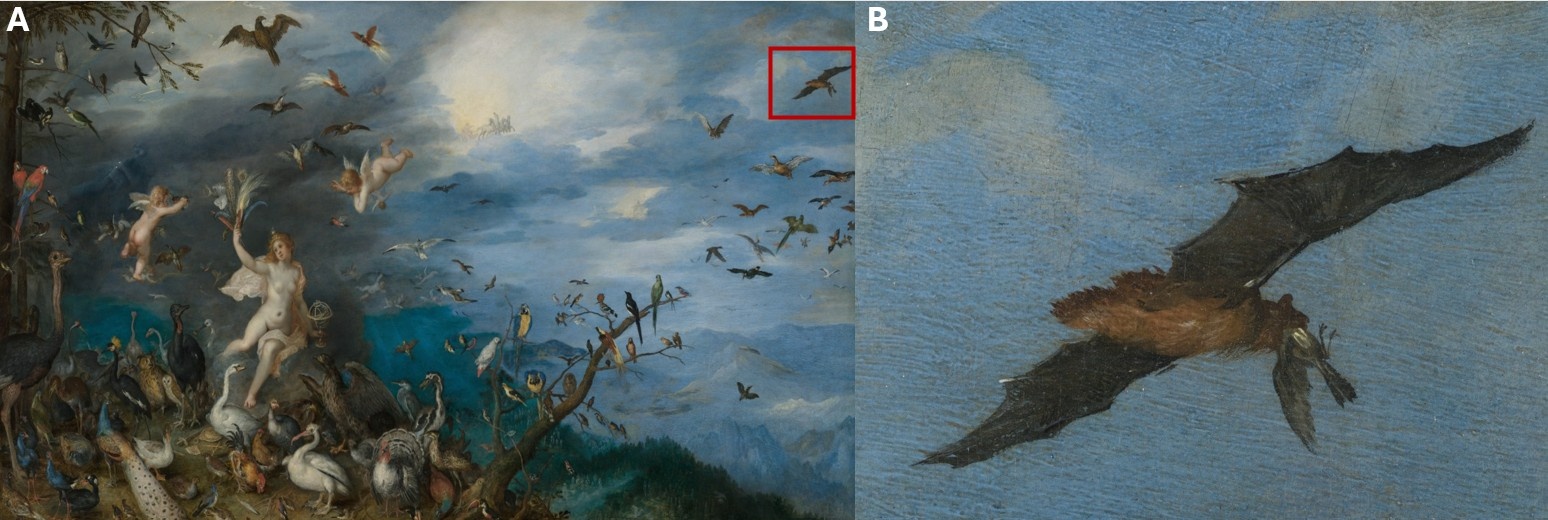
A detail of a noctule bat hunting a bird, depicted in the painting "Air" by Jan Brueghel the Elder in 1611.
A study led by the Doñana Biological Station (EBD-CSIC) provides new evidence that the predation of passerine birds by noctule bats was already known in the 17th century, around 400 years before science was able to demonstrate it conclusively. The research analyses Air, a painting by the Flemish artist Jan Brueghel the Elder, which depicts a bat carrying a small bird in its mouth.
It is only in recent years that scientists have conclusively shown that some European bats regularly prey on migratory birds. The first robust evidence of this behaviour emerged just two decades ago through analyses of bat droppings, movement tracking and molecular techniques.
One of the most significant breakthroughs came last October, when a research team led by the Doñana Biological Station (EBD-CSIC) demonstrated that the greater noctule, the largest bat species in Europe, is capable of catching and eating birds in mid-flight. The team made the first-ever recording of a greater noctule attacking and preying on a European robin in the air at Doñana, providing the first direct evidence of this remarkable hunting behaviour.
The new study has now uncovered an intriguing historical clue in Air, painted in 1611 by Jan Brueghel the Elder and housed at the Museum of Fine Arts of Lyon. The work depicts more than 60 bird species and at least three bat species. Among them is a clearly identifiable noctule bat, most likely a giant noctule (Nyctalus lasiopterus), holding a passerine bird in its mouth.
Although the scene does not perfectly match current scientific understanding of how these bats capture their prey, the authors argue that the painting nevertheless indicates that the artist was aware of this predatory behaviour centuries before it was documented by science.
"The painting suggests that certain observations about natural history may have formed part of the visual and observational culture of the time, even if they were never formally recorded in the scientific literature," says Pedro Romero Vidal, a researcher at the Doñana Biological Station.
Art and natural history
Beyond its implications for bat ecology, the study underscores the scientific value of historical artworks as a source of information on biodiversity and animal behaviour. The digitization of museum collections, together with the detailed analysis of historical paintings, is enabling researchers to recover observations of wildlife made centuries before the emergence of modern science.
According to the research team, the study demonstrates that works of art can complement contemporary scientific research and provide unexpected insights into the natural history of the past.
Reference
Pedro Romero Vidal, Sonia Sánchez Navarro, Elena Tena, Miguel Clavero. Natural history on canvas: Brueghel knew about bird-eating noctule bats. PNAS. https://doi.org/10.1073/pnas.2536525123