3D-printed flowers designed to monitor pollinators in the field
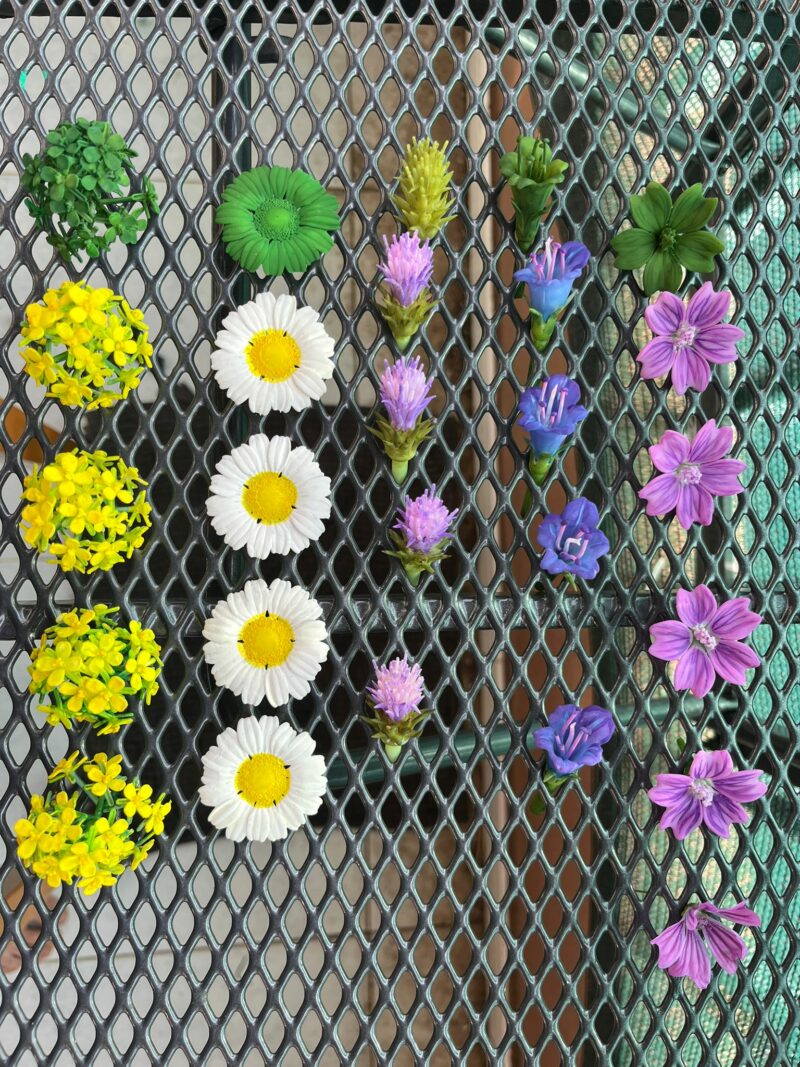
An international research team led by the Doñana Biological Station (EBD-CSIC), with the participation of the University of Jaén, has validated the use of 3D-printed artificial flowers as a tool for monitoring pollinator populations. The study, published in the journal Biological Conservation, has demonstrated that these models attract insects under real field conditions and can serve as a reference for comparing the activity of bees, flies, butterflies, beetles and other flower visitors in different locations and at different times of day. In the long term, this approach could be integrated into automated systems using cameras and artificial intelligence, contributing to larger-scale European pollinator monitoring programmes.
The results show that the models reflected relative patterns: in other words, locations with more species and more visits to real flowers also recorded greater activity on the printed flowers. However, artificial flowers generally attracted fewer visits than real flowers.
The most direct application of this work would be to advance towards automated monitoring systems that are non-invasive, inexpensive and easily scalable. "Rather than relying on in-person observations or captures, 3D-printed flowers equipped with cameras and sensors could be installed to record insect visits. They could also be combined with algorithms to help identify the species," explains EBD-CSIC researcher Carlos Martínez Núñez.
Non-invasive method
The research team is addressing a growing conservation challenge: understanding how pollinator populations change over time without necessarily resorting to invasive methods or techniques that are difficult to replicate on a large scale. "Over recent decades, numerous studies have warned of the decline of these insects, which are essential for the reproduction of many wild plants and crops. To protect them, it is not enough to know that their numbers are falling; we need to measure where, when and how their communities are changing," the researcher points out. Photomonitoring systems typically use cameras installed in the field to observe insects. These tools can record visits over long periods, access areas where it is difficult to maintain on-site observers and, when combined with artificial intelligence, help identify the species appearing in the images. However, these methods still have limitations, since natural flowers change throughout the year and during their life cycles. In addition, wind can move the plant and trigger the camera even when no insect is present, consuming battery power and generating unusable images. Another issue is that the animal's position on the flower does not always allow it to be clearly seen and identified. 3D-printed flowers offer a possible solution to these problems. Because they are all identical, they make it easier to compare results across locations, years and projects, with less variation. They can also be positioned and designed to help cameras capture clearer images of insects when they land on them.
Field trials in Granada
To assess their usefulness, the team placed 64 3D-printed flower models on real mallow plants at 16 field sites in Moraleda de Zafayona, Granada, each separated by at least 250 metres. At each site, they installed four artificial flowers and compared them with natural flowers from the same plant, in a Mediterranean landscape consisting of traditional olive groves and scrubland.
They prepared several models: some reproduced only the shape of the flower, others added colour, some incorporated ultraviolet patterns, and others included a small sugary reward to test whether these stimuli increased insect visits. "All the models performed similarly, suggesting that it is not necessary to design flowers with numerous stimuli to attract a significant number of pollinators," adds the EBD-CSIC researcher.
The team conducted observations over 16 days, from mid-April to late May 2025. At each field site, a researcher recorded insect visits to both natural flowers and 3D-printed models through direct observation for two hours, completing a total of 32 hours of observation. A total of 45 flower-visiting species were recorded, 23 of which also landed on the artificial models. Although natural flowers attracted more species, more visits and longer visits, the artificial ones provided a useful signal for comparing activity between locations.
The researchers also observed that not all pollinators respond in the same way to printed flowers. Smaller bees were more likely to visit them than larger species. The researchers suggest that this could be due to differences in how each species explores its surroundings, detects resources or distinguishes between real and artificial flowers.
"The most important finding for its practical application is that species richness and visit frequency on real and artificial flowers were strongly correlated. In other words, when a location had greater diversity or more activity on natural flowers, the printed flowers also recorded more visitors," Martínez explains. According to the researcher, this