An international study involving the Doñana Biological Station shows that the wintering areas of the European pied flycatcher are determined by both genetic inheritance and natal environment. The research reveals that all birds, from Spain to Siberia, migrate via the Iberian Peninsula and the West African coast, representing a major detour for Siberian populations. Understanding the links between breeding and wintering areas improves predictions of how migratory species may adapt to climate change.
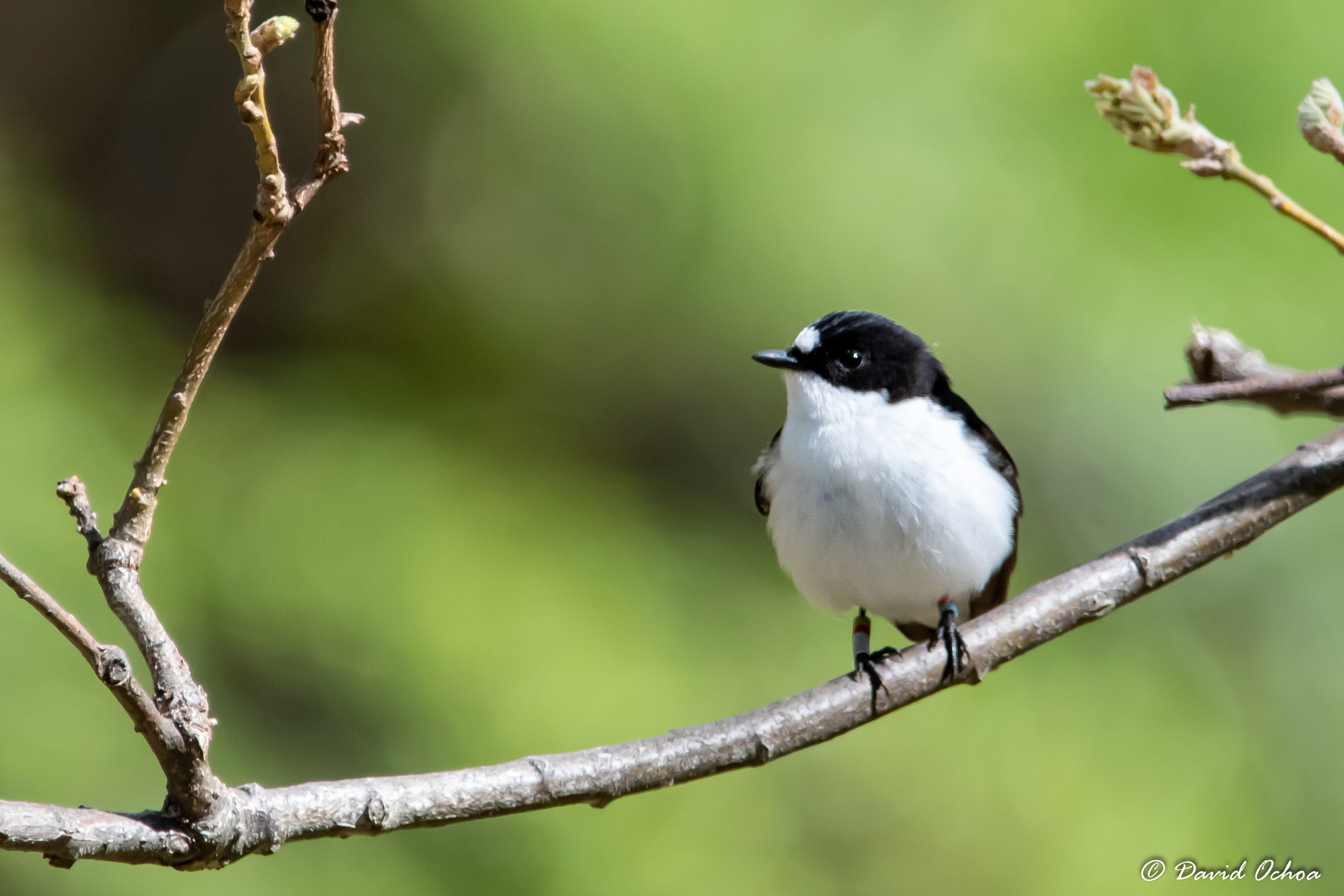
Male European pied flycatcher in La Hiruela, Madrid. / David Ochoa
An international team of scientists, including researchers from the Doñana Biological Station (EBD) of the Spanish National Research Council (CSIC), has discovered that the African wintering grounds of the European pied flycatcher, a small migratory songbird, are determined by both genetic factors and the environmental conditions experienced during the earliest stages of life. The study, published in Science, provides one of the first experimental demonstrations of how migratory birds select their winter destinations.
Every year, millions of birds travel thousands of kilometres between their breeding and wintering grounds. In many species, individuals born in the same region tend to spend the winter relatively close to one another. However, the reasons behind this pattern have remained unknown in species such as the European pied flycatcher, which migrates alone and mostly at night, with no opportunity to learn migration routes from parents or other experienced individuals.
A 13,000-kilometre journey for a 12-gram bird
To unravel this mystery, the research team fitted geolocators to European pied flycatchers from eight breeding populations ranging from Spain to western Siberia. These miniature light sensors, weighing only a fraction of a gram, record every sunrise and sunset, allowing researchers to estimate the bird's geographical position throughout the year once the data are retrieved. After recapturing the birds at their breeding sites the following year, the team successfully reconstructed each individual's annual migration route.
The results revealed a migration pattern that was as spectacular as it was unexpected. All populations of pied flycatcher converged on the Iberian Peninsula during autumn migration before travelling south along the West African coast. After an extended stopover, the birds undertook a non-stop flight of approximately 30 hours to the westernmost tip of Africa, from where they gradually moved eastwards to occupy different wintering areas.
While Spanish birds settled in Senegal and neighbouring regions, Siberian birds continued as far as the Central African Republic after travelling nearly 13,000 kilometres. Paradoxically, a direct route across the eastern Mediterranean would have shortened their journey by around 4,500 kilometres, substantially reducing both energy expenditure and the many risks associated with migration. Yet they consistently continue to migrate via Spain.
"It is difficult to find an adaptive explanation for such an enormous detour," says Koosje Lamers, researcher at the University of Groningen and first author of the study. "Everything suggests that this route may be an evolutionary relic from a time when the species was restricted to western Europe and Africa," explains Lamers.
A combination of genes and environment
To investigate why birds from different populations winter in different regions, the researchers conducted a five-year experiment between the Netherlands and Sweden. Eggs laid by Dutch pied flycatchers were transferred to Swedish nests located 500 kilometres away, where they were incubated and raised by Swedish foster parents. The fostered chicks were later equipped with geolocators to monitor their migration. In addition, naturally occurring mixed-ancestry offspring born in Sweden from crosses between Dutch and Swedish birds were also fitted with geolocators before leaving the nest.
The differences were striking. Dutch pied flycatchers spent the winter approximately 500 kilometres farther east than Swedish birds. However, Dutch birds raised in Sweden settled in intermediate locations, while birds of mixed ancestry wintered even closer to the areas used by the Swedish population. These findings demonstrate that the winter destinations of these small migrants are determined by a combination of genetic and environmental influences. Furthermore, the results suggest that what is genetically encoded is not necessarily a specific migration route from the breeding grounds but, at least in part, the duration of the migratory programme.
The environmental effect on migration routes and final winter destinations is closely linked to migration timing. Dutch birds, breeding farther south, reproduce and migrate earlier than Swedish birds. By contrast, the shorter and later northern summer forces Swedish birds to begin migration later in the season. Genetics determines key temporal aspects such as the duration of the migration programme, while the natal environment also influences the final destination, even among individuals with the same genetic background. This explains why Dutch birds winter farther inland in Africa, whereas Swedish birds remain farther west.
Key insights into adaptation to climate change
The study also demonstrates that wintering areas are established during the birds' first autumn migration and that individuals consistently return to the same African regions year after year. This finding has important implications in the context of global environmental change.
"The location where birds spend the winter determines when they can begin their return migration and, consequently, when they arrive at their breeding grounds," explains Carlos Camacho, migration specialist at the Doñana Biological Station. "That synchronisation is becoming increasingly important in a rapidly warming world," the researcher adds.
Understanding how breeding and wintering areas are connected will improve our ability to predict how migratory species may adapt to environmental change. It will also help develop more effective conservation strategies for birds that depend on ecosystems spanning multiple continents.
Reference
Lamers, K.P., Ouwehand, J., Ubels, R., Nicolaus, M., Camacho, C., Potti, J. … & Both, C. 2026. Innate factors and ontogeny determine non-breeding areas of migrant songbirds. Science, DOI: 10.1126/science.ads0532