New project will examine how a total solar eclipse alters insect behaviour
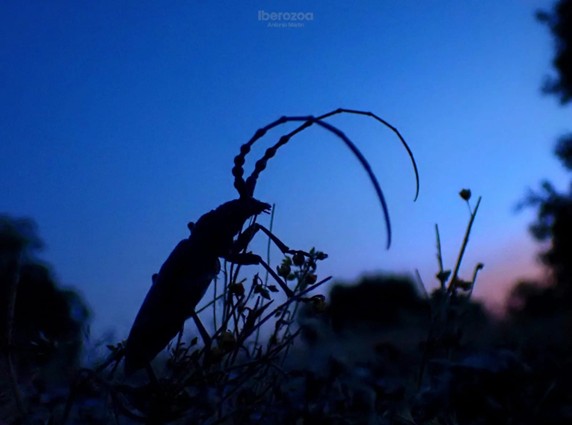
Macho de Agopanthia, sp, durante el atardecer en Tres Cantos (Madrid). Foto: Antonio Martín Higuera.
An international team of scientists, including researchers from the Doñana Biological Station (EBD-CSIC), will study how insects respond to the sudden darkness created by the total solar eclipse that will cross the Iberian Peninsula on 12 August.
The eclipse has prompted numerous scientific projects, ranging from astronomical observations to studies of wildlife behaviour. While birds are expected to show a sharp decline in activity and song during the temporary darkness, insects are predicted to respond differently, with nocturnal species becoming active earlier than usual.
“Crepuscular species, which typically begin their activity at the onset of darkness, are likely to be the first to respond to this false twilight," says Marcos Méndez, researcher at the Global Change Research Institute of Rey Juan Carlos University (IICG-URJC).
Sampling sites along the eclipse path
"What makes this study unique is that we will not only analyse how different groups of insects react to a sudden change in light under natural conditions, but we will do so simultaneously at multiple sampling sites distributed across the entire path of the eclipse," explains Jairo Robla, researcher at the Doñana Biological Station.
Sampling stations will be established along the eclipse's route across the Iberian Peninsula, from Galicia to Castellón, including sites in Asturias, Castile and León, and Madrid. Each station will be equipped with an identical ultraviolet light trap designed for the Phalaena project of the Spanish Butterfly Conservation Association (ZERYNTHIA), which attracts insects that are normally active at night.
"We expect to attract moths and beetles, but probably also other groups of flying insects such as flies and wasps. All traps are identical and will be placed in open habitats along the eclipse path," says Marcos Méndez.
To isolate the effects of the darkness caused by the eclipse, all sampling will take place in areas free from artificial lighting. "Any surrounding light pollution would make it much more difficult to interpret the insects' responses," Robla adds.
Using this experimental design, the researchers expect to detect changes in the abundance and detectability of several insect groups, particularly species whose activity depends on moonlight and lunar cycles for movement, mate finding, or reproduction.
The study will also include reference surveys conducted at the same time on the days immediately before and after the eclipse, together with standard nighttime sampling on all three days. This will allow researchers to compare insect activity during the eclipse with normal conditions.
Most studies on insect responses to changes in light have been carried out under laboratory conditions and have focused on individual species. A total solar eclipse provides a rare but invaluable opportunity to investigate how entire insect communities respond under natural conditions. The event will help researchers identify differences in sensitivity to darkness among insect species and improve our understanding of how they adjust their activity to natural changes in light levels.
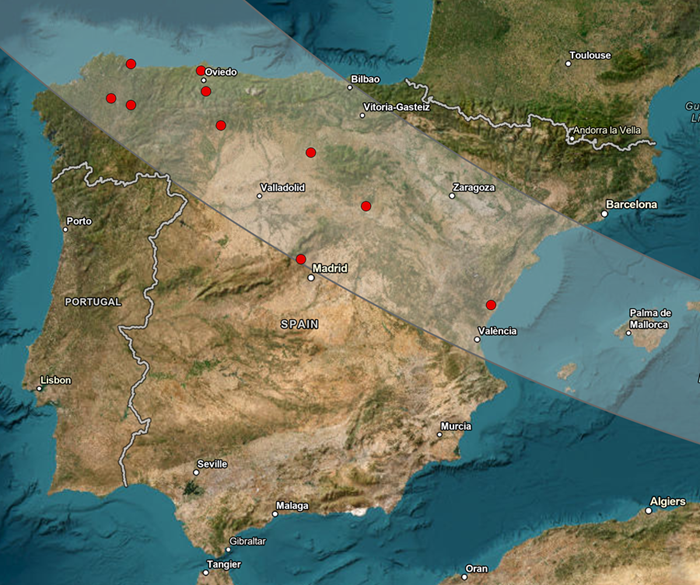
Sampling sites along the eclipse path. Photo: Tom Sheehan.
Learning from previous total solar eclipses
Total solar eclipses provide a unique natural experiment for investigating how wildlife responds to an abrupt reduction in daylight. While the effects of artificial light at night have been extensively studied, it is far more difficult to recreate the opposite process experimentally. During the 2024 total solar eclipse in the United States, a pilot study showed that the brief period of darkness triggered activity in crepuscular insects.
"This study will provide valuable insights into the light-response thresholds of different insect species, ranging from those that react to very small decreases in light intensity to species that require near-complete darkness before becoming active," concludes the IICG-URJC researcher.
The 2026 eclipse will build on previous pilot studies by incorporating a coordinated sampling network spanning the entire eclipse path across the Iberian Peninsula. The findings will improve our understanding of how different insect communities respond to one of the most abrupt changes in natural light that can occur in the environment.
The research team that will take in this project comprises more than 12 scientists and is led by Tom Sheehan, a doctoral researcher at the University of Georgia. In addition to Rey Juan Carlos University and the Doñana Biological Station, the project involves The Jones Center at Ichauway, the University of Santiago de Compostela, the National Museum of Natural Sciences (CSIC), the Institute of Agricultural Sciences (CSIC), Jaume I University, the University of Oviedo, the University of León, and the Spanish Butterfly Conservation Association (ZERYNTHIA).