New study reveals that the actual number of animals killed on roads is far higher than official counts suggest
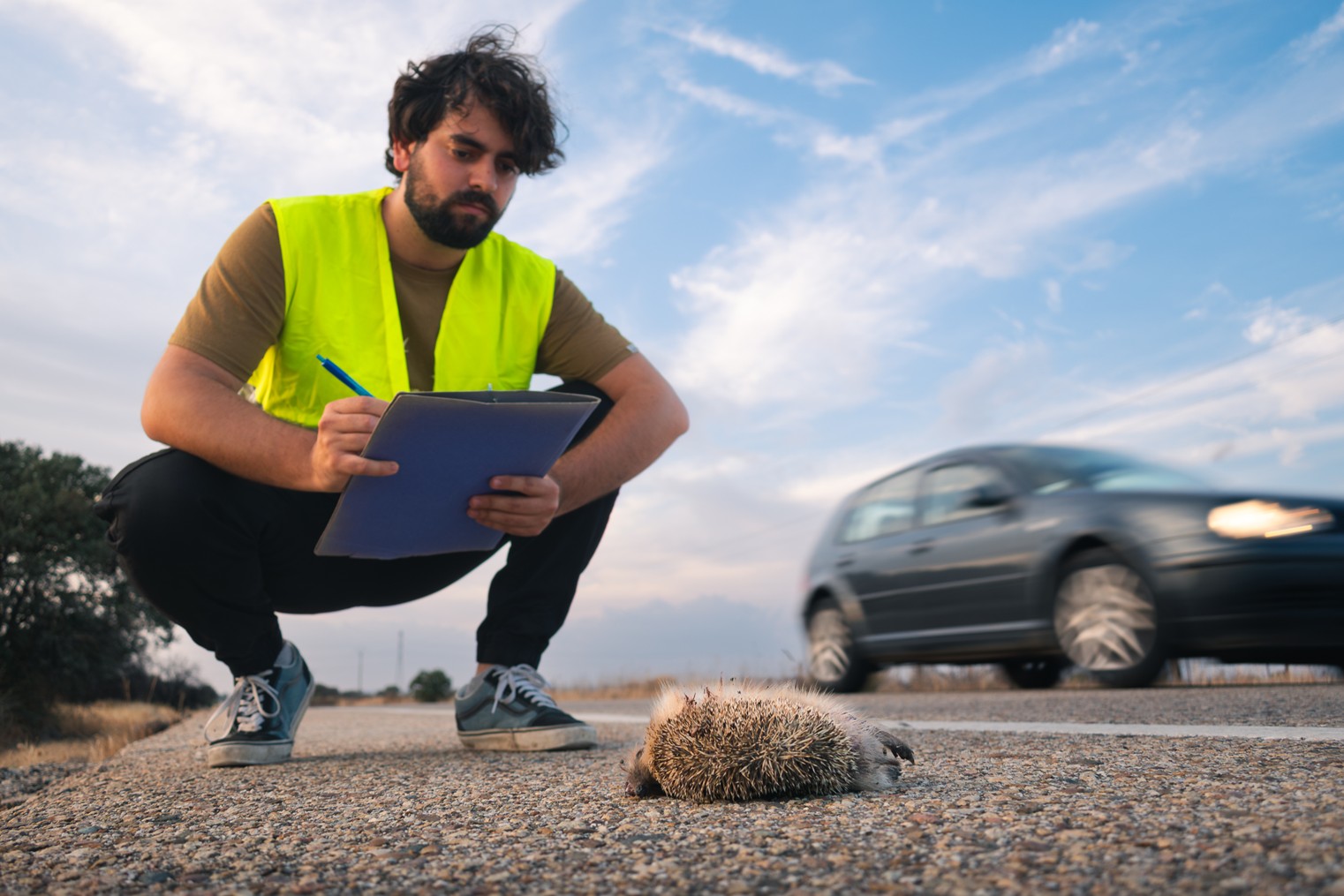
Researcher Guillermo Gómez-Peña conducting a roadkill survey. Credit: Javier Alfaya
Human infrastructure, such as roads, poses a significant threat to wildlife. Although estimates exist of the number of animals killed on roads, not all victims are recorded. A new study by the Doñana Biological Station (EBD-CSIC), published in Methods in Ecology and Evolution, presents a model designed to estimate the actual number of deaths by accounting for factors that make accurate counts difficult.
Across the roads surveyed, researchers recorded 650 carcasses belonging to 45 species. The model revealed that conventional counts substantially underestimate actual mortality. For small birds, for example, surveys recorded eight roadkill incidents per kilometer, while the model estimated nearly 49 — more than six times as many. The difference was even more pronounced for reptiles such as snakes: estimated mortality was 14 times higher than the recorded figure, rising from fewer than one individual per kilometer to almost nine.
Mortality estimates based on surveys of infrastructure such as roads are much lower than the actual figures because we can only record the animals we manage to detect. This study presents a statistical method that corrects for these losses of information and provides a more accurate estimate of the number of animals killed by infrastructure,” explains Guillermo Gómez-Peña, the study’s lead author and a researcher at the Doñana Biological Station (EBD-CSIC).
Accounting for sources of bias
Most assessments of road-related wildlife mortality do not account for certain sources of bias. As a result, simply counting animal carcasses underestimates the true impact of roads on wildlife.
The proposed model accounts for three factors that can affect how accurately roadkill numbers are estimated. The first is carcass location, since many animals do not end up on the road itself after being struck. The second is carcass persistence. Before a survey takes place, carcasses may disappear from the study area due to decomposition, scavenger activity, repeated crushing by vehicles or road maintenance work. Finally, the model accounts for imperfect detection — cases in which observers fail to spot carcasses that are still within the survey area.
“By correcting for each of these processes using the data we do manage to collect, the model estimates actual mortality. We also surveyed the same roads on foot, by bicycle and by car, following the SAFE Project protocol. This allowed us to estimate the probability of detecting carcasses with each method and compare how effective they were at identifying roadkill,” Gómez-Peña adds.
Recommendations for future research
To ensure that these statistical estimates are reliable and useful for conservation planning, the study sets out several guidelines for future research. These include the need for robust baseline data on how long carcasses remain in the study area and the probability of detecting them. The research team also recommends using sampling methods that complement vehicle-based surveys, which often miss smaller animals, and tailoring survey designs to specific species.
“When mortality is underestimated, the threat roads pose to wildlife is downplayed, and we may fail to identify the species most at risk. Estimating the true number of deaths allows us to make better-informed management and conservation decisions,” Gómez-Peña concludes.
Referencia
Gómez-Peña, G., D'Amico, M., Rodríguez, C., Román, J., García-Rodríguez, A., Revilla, E. & Paniw, M. (2026). A method to estimate actual infrastructure-induced mortality by integrating hierarchical sources of imperfect detection. Methods in Ecology and Evolution. https://doi.org/10.1111/2041-210x.70382