A visual warning of climate change: Frogs darken their irises in response to dehydration
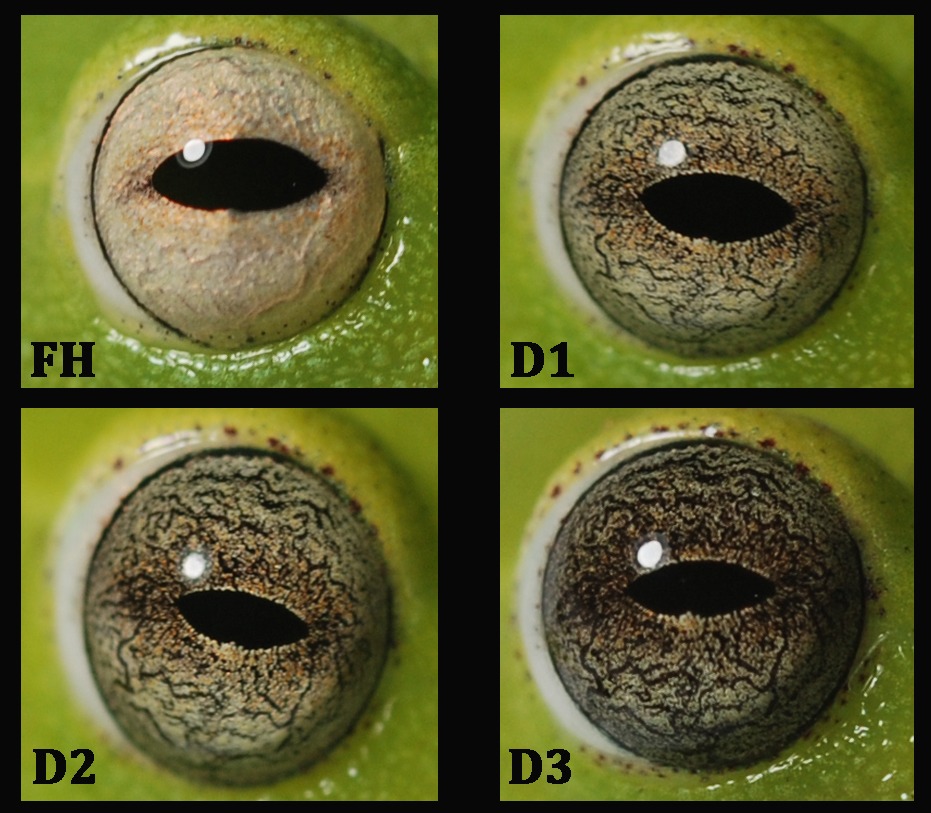
Progressive variation in iris darkening in the right eye of an individual of Boana punctata across hydration treatments
An international team of researchers from the Doñana Biological Station (CSIC), the University of Córdoba, and CONICET (Argentina) has discovered a new physiological indicator of water stress in amphibians: iris darkening. The study, published in the Journal of Experimental Zoology Part A (2026), shows that the neotropical frog Boana punctata progressively darkens its iris as it loses water—a change so consistent that it is proposed as a non-invasive biomarker for assessing dehydration in wild populations.
Amphibians rely heavily on water to maintain their physiological balance, and their permeable skin makes them especially vulnerable amid increasing droughts. Identifying rapid, reliable signs of water stress is key to anticipating ecological impacts.
In the study, 25 adult B. punctata were subjected to controlled dehydration using two methods (airflow and desiccant rice). Throughout the process, each individual's iris was photographed, and the darkened area was quantified through image analysis. The results were clear: for every 1% of body water lost, the iris darkened by about 1.5%—a linear, robust relationship that was nearly identical across individuals and methods. "Iris darkening is a rapid physiological response that is highly sensitive to the animal's water status," explains Ricardo Reques, author of the study. "What's most interesting is that we can measure it with a simple photograph, without any invasive handling."
After two hours of rehydration, the iris partially recovered its color, confirming that this is a dynamic, reversible mechanism. The authors suggest that this darkening may be mediated by the activation of melanophores regulated by stress hormones such as α-MSH and corticosterone.
This finding opens a promising avenue for amphibian monitoring in the field. In an increasingly arid world, the availability of a rapid, non-invasive visual indicator of hydration status could facilitate the assessment of the physiological condition of natural populations and provide an early warning of dehydration risk, much like the proverbial canaries in the coal mine.
This new biomarker could be applied in conservation programs, thermal ecology studies, and monitoring of species sensitive to climate change—offering a simple tool for understanding how amphibians cope with an increasingly dry world.
Reference:
Ricardo Reques, Eduardo F. Schaefer, Eduardo A. Sanabria, Leonardo D. Aguiar, Lorena B. Quiroga, Miguel Tejedo Eye Darkening Under Dehydration Stress in the Neotropical Frog Boana punctata. Journal of Experimental Zoology Part A: Ecological and Integrative Physiology. https://doi.org/10.1002/jez.70118