An international study led by the University of Freiburg, with the participation of the Doñana Biological Station – CSIC, has analyzed wildlife activity in the Chernobyl Exclusion Zone before, during, and after the 2022 Russian occupation
The results reveal immediate changes in the activity patterns of several mammal species due to military activity, with impacts varying depending on the species and the intensity of the disturbance
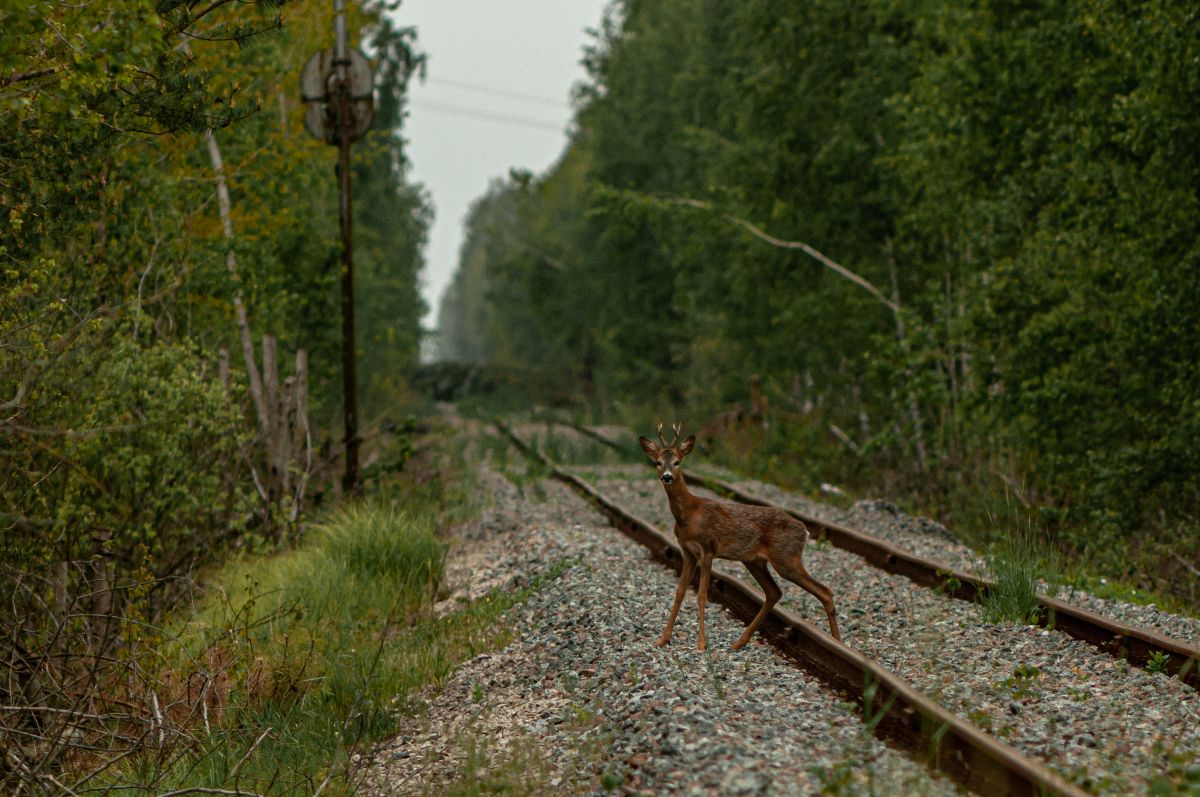
A roe deer crosses railway tracks near the deserted village of Novoshepelychi. Photo credit: Kateryna Korepanova
An international study led by the University of Freiburg, with participation from the Doñana Biological Station (EBD-CSIC), has documented behavioral changes in the wildlife inhabiting the Chernobyl Exclusion Zone triggered by the 2022 Russian invasion. Utilizing a network of camera traps set up prior to the invasion, this research is the first globally to analyze the impacts of warfare on biodiversity in before, during, and after the conflict, rather than solely evaluating the aftermath. Although the impact varied by species, the findings, published in the journal Science, highlight significant behavioral disruptions, including a marked reduction in nocturnal activity among deer and foxes.
Chernobyl is currently one of Europe's largest wildlife sanctuaries. The well-known Exclusion Zone —a restricted area with a 30-kilometer radius surrounding the nuclear power plant— was occupied by Russian forces for 35 days between February and March 2022. According to the research team, the brevity of this occupation makes it difficult to establish clear, long-term trends. Nevertheless, they observed immediate behavioral shifts across numerous species, each responding in distinct ways. In addition to reduced nocturnal activity in deer and foxes, the findings highlight fluctuations in the presence of roe deer, hares, and the Eurasian lynx, among other mammals, directly correlating with the intensity of military activity.
A casual scientific experiment in the middle of the Russian invasion
The study was born out of serendipity. Over the past few decades, the Chernobyl Exclusion Zone —abandoned following the 1986 nuclear disaster— has evolved into a vital natural laboratory for studying ecological restoration processes. “The minimal human presence in the area has driven a resurgence in wildlife populations. It has also facilitated the recolonization of species that had gone locally extinct before the disaster, such as the brown bear and the Eurasian lynx, alongside others that weren't previously as abundant, like moose, red deer, wild boar, and wolves,” explains Svitlana Kurdenko, a researcher at the University of Freiburg and lead author of the study. Furthermore, a project was launched in the 1990s to reintroduce the endangered Przewalski’s horse.
Against this backdrop, in January 2021, exactly one year before the Russian occupation, a monitoring project was initiated using a camera-trap network to track the Eurasian lynx population inhabiting the Zone. A year later, Russian military forces occupied the area from February 24 to April 1, 2022, using it as a strategic corridor to advance toward Kyiv. Throughout this period, the region endured shelling, heavy military vehicle movements, wildfires, and other conflict-related disruptions.
Once Russian forces withdrew, the scientific team realized that amid the tragedy of war lay a unique opportunity to observe how wildlife responded to combat-induced disturbances. Months later, researchers successfully retrieved data from 31 cameras, aided by the Armed Forces of Ukraine, who cleared and secured the area. The terrain was riddled with anti-personnel landmines, which claimed the lives of at least three Przewalski’s horses. “Beyond our original research scope, we were able to investigate phenomena that, until now, had only ever been studied within military training zones,” notes Marco Heurich, study co-author and fellow researcher at the University of Freiburg.
Different responses in a military conflict environment
The scientific team analyzed the behavior of eleven different animal species. “Initially, we hypothesized that in response to the disruptions caused by armed conflict, animals would become more nocturnal and vigilant, while avoiding areas with a continuous human presence. This type of behavior is well-documented, and we assumed it would intensify during the armed conflict,” explains Svitlana Kudrenko. However, while this held true for some of the species studied, it did not align with the behavior of others. For instance, foxes and deer actually reduced their nocturnal activity compared to the same period the previous year in response to the escalating intensity of the conflict.
Additionally, roe deer sightings decreased during periods of peak military activity, whereas hare sightings rose during thermal anomalies linked to wildfires, reflecting how highly sensitive these species are to environmental stressors. During the occupation, these animals may have shifted from viewing humans merely as a source of disturbance to a lethal threat similar to natural predators, carrying potential ecological and evolutionary consequences.
Nevertheless, not all species avoided human settlements. While wild boars and raccoon dogs appeared to shun them, foxes and lynx were detected more frequently near these sites, suggesting they utilized them as a valuable source of resources.
An understudied dimension
The research team warns that the observed effects may represent only a fraction of the war's true ecological consequences. Prolonged military activity could trigger deeper shifts in habitat use and species behavior, ultimately altering community structures and long-term population dynamics.
“Since the Russian invasion, Chernobyl has shifted from a unique case of passive rewilding in the absence of humans to a zone of intense military activity, where field research is severely restricted,” explains Nuria Selva, a researcher at the Doñana Biological Station and co-author of the study. “In today’s geopolitical climate, there is an urgent need to step up funding and support for scientists working in these regions, as conflict zones continue to multiply. Initiatives like SAFE, which provides fellowships for researchers at risk due to discrimination, persecution, or violence to continue their work at other European institutions, must be sustained. The war in Ukraine is not over.”
This research shines a spotlight on the environmental toll of armed conflicts, a dimension of biodiversity loss that remains poorly understood. Beyond the devastating human cost, warfare can cause severe population declines, ecological disruptions, and, in some cases, localized extinctions. Concurrently, recent advancements in remote and automated monitoring technologies offer new avenues to study these impacts without putting researchers at risk. Against a backdrop of rising global militarization and environmental crises, the research team is calling for targeted strategies to monitor, study, and protect ecosystems caught in the crossfire.
Reference
Svitlana Kudrenko, Richard Bischof, Andreas Zedrosser, Nuria Selva, Kateryna Korepanova, Denys Vishnevskiy, Martin Gahbauer, Serhii Obrizan, Serhii Domashevskiy, Oleksandr Borsuk, Alona Varukha, Marco Heurich. Changes in wildlife activity patterns in response to war in Ucraine. Science www.doi.org/10.1126/science.aed1493