Droughts and shortage of preys pushes lynx to prey on black kite chicks in Doñana National Park
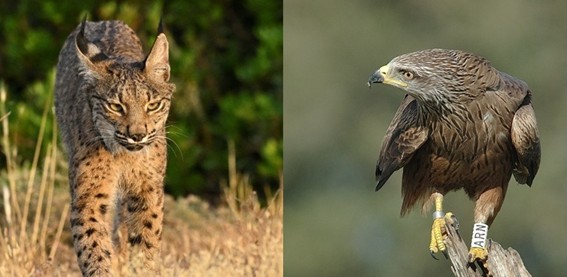
Left: Iberian lynx (Lynx pardinus). Right: black kite (Milvus migrans). / Fabrizio Sergio
In Doñana National Park, Iberian lynxes have begun preying on the fledlings of a raptor, the black kite, removing up to almost half of the young birds in the study area in 2018. This is no arbitrary change in behaviour: a shortage of their usual prey, combined with drought, has driven these protected animals to seek alternative food sources. The scale of predation is unprecedented in the three decades researchers have spent studying both species in a 10-square-kilometre area of the national park. Until now, they had coexisted, feeding on rabbits.
These are the findings of a new study by the Doñana Biological Station (EBD-CSIC), part of the Spanish National Research Council (CSIC), published in Nature. The research analyses 1,624 black kite nests monitored between 1993 and 2023. “Between 1993 and 2012, lynxes had preyed on barely 1% of black kite nests,” explains Fabrizio Sergio, a researcher at EBD-CSIC and lead author of the study.
According to the research team, this sudden conflict between the two predators stems from the combination of two factors. On the one hand, the spread of an infectious disease has caused rabbit populations in Doñana to collapse. On the other, prolonged periods of drought have reduced the availability of alternative prey for lynxes, such as the ducks that inhabit the marshes.
A new relationship between lynxes and black kites
Historically, rabbits have been abundant in Doñana, allowing lynxes and black kites to coexist peacefully for decades. However, after rabbit haemorrhagic disease caused rabbit populations to decline in 2013, lynxes began preying heavily on black kite chicks, but only during periods of water scarcity.
“During drought years, the lynx’s main alternative prey, such as ducks, also become very scarce. This leaves lynxes with little choice but to eat whatever they can find, even if that means climbing 12 metres to reach a black kite nest and prey on its chicks,” explains Fabrizio Sergio.
The researchers also observed that lynxes were more likely to prey on black kite nests that had rabbit remains fallen on the ground beneath them, pointing to a possible additional motive: eliminating competitors. “In human terms, we could say that black kites that dared to take food away from lynxes ended up paying a very high price,” says Sergio. “Lynxes have managed to wipe out nearly half of the local population of fledgling black kites.”
In response, adult black kites who suffered nest predation by lynxes were more likely to abandon their territories and move elsewhere. This response suggests a kind of contest between the two species: lynxes eliminate a competitor for food, while black kites try to avoid them by relocating.
The disruption of this predator relationship also had consequences for other species. For example, the decline in black kites has benefited a small insect-eating owl, the little owl (Athene noctua), which is preyed upon by these raptors and whose population has increased. This suggests that drought-driven interactions between predators can affect lower levels of the food web, demonstrating that the ecological consequences extend to more complex aspects of community structure and biodiversity.
Combined threats, cascading effects
Climate change is altering interactions between species, and when combined with other threats, it can trigger unexpected consequences and amplify their effects.
“These cascading effects, which can unfold unnoticed over many years, highlight the need to address the different pressures affecting ecosystems together, since one can amplify the impact of another,” explains Fabrizio Sergio.
Furthermore, because of their position and influence in the food chain, apex predators can amplify the effects of global change on other species. In Doñana, the research team argues, conserving these predators requires restoring rabbit populations and ensuring an appropriate flooding regime in the Guadalquivir marshes. This would help maintain prey availability and reduce the vulnerability of these species to drought.
Despite the scale of these changes, the species studied displayed resilience strategies that improved their ability to cope with climate change. Lynxes changed their feeding habits, black kites responded to predation by moving to other territories, and little owls occupied the ecological space left by the black kites. These responses show that wildlife can demonstrate some capacity to adapt to changing conditions.
Decades of monitoring and research
The discovery of this previously undocumented interaction was made possible by the long-term scientific monitoring carried out in Doñana. Continuous observation of both species over several decades enabled researchers to identify a change that would have been difficult to detect through short-term studies and to reconstruct the sequence of events that triggered it.
“Without decades of effort by researchers, it would have been impossible to identify this interaction. Support for this kind of long-term study is becoming increasingly scarce, which will seriously undermine scientific progress in this field,” concludes Sergio.
The findings therefore highlight the importance of maintaining long-term monitoring programmes to understand how ecosystems respond to environmental pressures and to anticipate changes in ecological relationships.
Reference
Sergio, F., Natsukawa, H., Tanferna, A., Chicano, J., Carro, M., Soriguer, R.C., Hiraldo, F. & Blas, J. 2026. Drought and disease trigger novel interactions among top predators. Nature. DOI: https://doi.org/10.1038/s41586-026-11194-z