13 March 2026
First evidence of carnivorous mammals preying on adult pine processionary moths
The findings suggest that generalist carnivores such as foxes and martens may play a previously unknown role in the natural control of this well-known forest pest. The study has been conducted by the Doñana Biological Station (EBD-CSIC) and the University of Huelva.
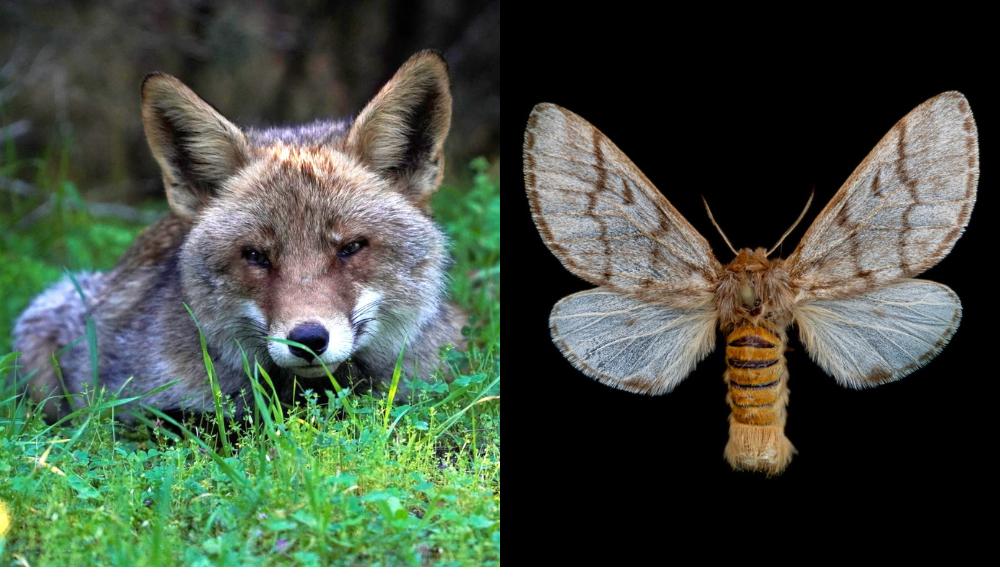
Left: red fox (Vulpes vulpes). Credit: Joaquín Alonso / EBD-CSIC.
Right: adult female pine processionary moth (Thaumetopoea pityocampa). Credit: Jacinto Román.
A scientific team from the Doñana Biological Station (CSIC) and the University of Huelva has documented for the first time an unexpected behavior in several carnivorous mammals: the predation of adult female pine processionary moths, one of the best-known forest pests in the Mediterranean region. The study, published in the journal Ecosphere, provides new clues about the role that generalist predators may play in the natural control of this species.
The pine processionary moth (Thaumetopoea pityocampa) is a moth species that feeds on the needles of pine and cedar trees. In addition to its effects on vegetation, the caterpillars possess urticating hairs that can cause allergic reactions in both people and animals, making this species both an ecological and a public health concern. Although numerous studies had previously identified predators of its eggs, caterpillars, or pupae, the consumption of adult moths by carnivorous mammals had not been described until now..
The discovery comes from the analysis of carnivore feces collected between 2022 and 2024 in several Spanish natural areas, including the Sierras de Cazorla, Segura y Las Villas Natural Park, Sierra Nevada, and the Aracena Natural Park. Researchers examined samples belonging to species such as the red fox, the stone marten, the genet, and the badger.
The original aim of these analyses was to study trophic relationships among these carnivorous mammals, but some of the results drew particular attention. In a significant proportion of fox and stone marten samples, researchers found pine processionary eggs and small characteristic scales that females use to cover and protect their egg masses, indicating that the animals had consumed adult moths.
The results showed that nearly 19% of the fox feces and just over 11% of the stone marten samples analyzed in one of the study areas contained remains of adult processionary moths. On average, around 1,700 eggs were found in a single fox sample and about 700 in stone marten feces. During the study, no evidence was found that genets or badgers consumed adult processionary moths, although this possibility cannot be ruled out.
“This probably occurs because adult female processionary moths have limited mobility. After mating, we have observed that they sometimes walk along the forest floor to lay their eggs. This behavior makes them vulnerable to opportunistic terrestrial predators,” explains Jacinto Román from the Doñana Biological Station and first author of the study.
The study suggests that this type of predation could have interesting implications for the biological control of the pest. Each female carries around 200 eggs, so the removal of a single individual could significantly reduce the number of new caterpillars. Although the authors emphasize that more research is needed to determine how common this phenomenon is and its real impact on processionary moth populations, the results suggest that generalist carnivores may contribute more than previously thought to regulating outbreaks.
Ultimately, the study reinforces a central idea in forest ecology: ecosystems with diverse and well-preserved predator communities are often better able to keep potential pest species in check. A better understanding of these interactions, the authors note, may help develop forest management strategies that take advantage of the ecosystem’s own natural processes.
Reference:
Jacinto Román, Juan Carlos Rivilla, Javier Calzada, Francisco J. Palomares. Opportunistic predation by carnivore mammals on females of pine processionary moths, Thaumetopoea pityocampa. Ecosphere, https://doi.org/10.1002/ecs2.70542